

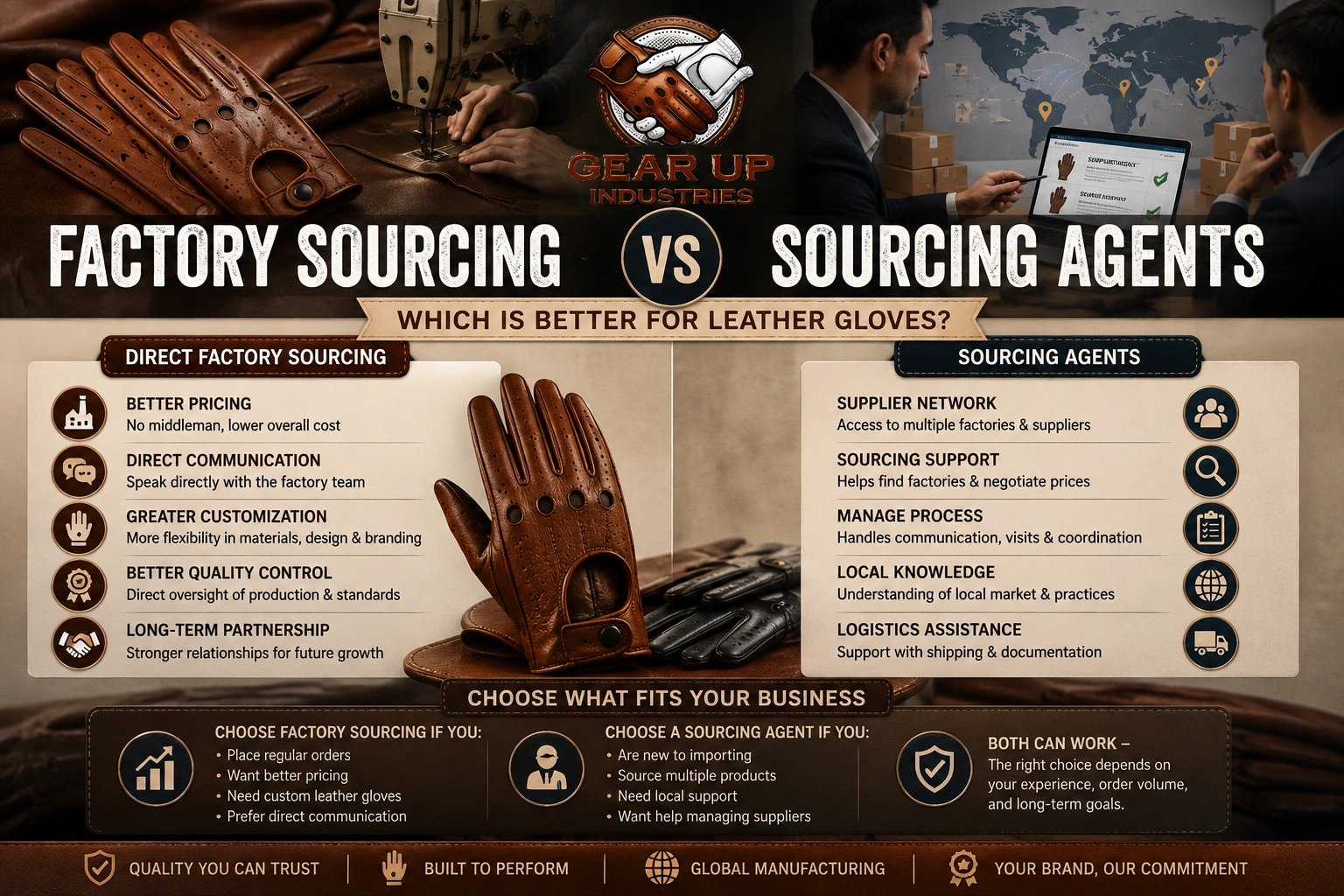
Finding the right manufacturing partner is one of the most important decisions when sourcing leather gloves in bulk. Before discussing leather grades, product specifications, or pricing, buyers must first decide how they want to source their products.
For many USA importers, the choice comes down to two options: working directly with a leather glove factory or hiring a sourcing agent to manage the process.
Neither approach is automatically better. The right option depends on your business experience, order volume, communication needs, and long-term sourcing goals. While some companies benefit from having a sourcing agent coordinate production, others save money and gain greater control by working directly with an experienced manufacturer.
In this guide, we’ll compare both sourcing methods, explain their advantages and limitations, and help you determine which option best fits your business.
If you’re still researching how to evaluate manufacturers, our B2B Sourcing Guide for Custom Leather Gloves Manufacturing provides a complete overview of the sourcing process before placing your first bulk order.
Understanding the Difference Between Factory Sourcing and Sourcing Agents
Before comparing the advantages of each approach, it’s important to understand what each option actually involves.
Many first-time buyers assume factories and sourcing agents perform the same role. In reality, they have very different responsibilities throughout the sourcing process.
What Is Direct Factory Sourcing?
Direct factory sourcing means working directly with the manufacturer that produces your leather gloves.
Instead of communicating through a third party, buyers discuss product specifications, sampling, pricing, production schedules, and quality requirements directly with the factory’s sales or export team.
Manufacturers like Gearup Industries handle every stage of production internally, allowing buyers to communicate directly with the people responsible for making their products.
Direct factory sourcing is commonly preferred by:
- Private label brands
- Established wholesalers
- Importers
- Distributors
- Retail chains
- Businesses placing repeat orders
Because communication happens directly with the production team, buyers often receive faster answers regarding materials, manufacturing timelines, and customization options.
Benefits of Working Directly With a Manufacturer
Working directly with a factory offers several advantages for businesses planning long-term sourcing relationships.
Some of the biggest benefits include:
- Direct communication with production teams
- Better pricing without third-party commissions
- Faster decision-making
- Greater product customization
- Better understanding of manufacturing capabilities
- Easier production planning for repeat orders
As businesses grow, these advantages become increasingly valuable because production can scale without introducing additional intermediaries.
Better Product Knowledge
Manufacturers understand their own production process better than anyone else.
When buyers ask questions about:
- Leather grades
- Stitching methods
- Pattern adjustments
- Logo embossing
- Sampling
- Production lead times
the factory can usually provide detailed answers immediately.
This direct communication often reduces misunderstandings that may occur when information passes through multiple parties.
Long-Term Relationships Create Better Results
Many successful brands continue working with the same manufacturer for years.
As both companies become familiar with each other’s expectations, production becomes more efficient, communication improves, and product consistency increases.
Instead of explaining product specifications for every order, buyers can build long-term manufacturing partnerships that support future growth.
What Is a Sourcing Agent?
A sourcing agent acts as an intermediary between buyers and manufacturers.
Instead of working directly with the factory, businesses communicate with the sourcing agent, who then coordinates production with one or more manufacturers.
Depending on the agreement, sourcing agents may assist with:
- Finding manufacturers
- Price negotiations
- Sample coordination
- Factory communication
- Quality inspections
- Production updates
- Export documentation
- Shipping coordination
For businesses new to international sourcing, this additional support can simplify the buying process.
When Businesses Choose Sourcing Agents
Sourcing agents are often used by companies that:
- Have no previous importing experience.
- Need suppliers across multiple product categories.
- Don’t have internal procurement teams.
- Face language or communication barriers.
- Require local factory visits.
Rather than contacting dozens of manufacturers individually, buyers can rely on the agent’s network to identify suitable suppliers.
This approach may save time, especially for businesses sourcing several different products from multiple factories instead of specializing in leather gloves alone.
Advantages of Working With a Sourcing Agent
A good sourcing agent can provide valuable support throughout the procurement process.
Common benefits include:
- Access to established supplier networks
- Assistance with factory selection
- Local market knowledge
- Independent factory visits
- Coordination between multiple suppliers
- Simplified communication
These services can be particularly useful for companies placing their first overseas orders or managing complex sourcing projects.
However, buyers should also understand that sourcing agents are not manufacturers. Their knowledge of production depends on the factories they work with, and communication typically passes through an additional layer before reaching the production team.
Comparing Cost: Factory vs. Sourcing Agent
Pricing is one of the biggest factors influencing sourcing decisions.
When working directly with a manufacturer, buyers negotiate pricing without paying an intermediary commission. This often results in lower overall sourcing costs, especially for repeat orders or long-term partnerships.
Sourcing agents, on the other hand, usually charge through a commission, service fee, or a margin built into the product price. While this additional cost may be worthwhile for businesses that need sourcing support, it’s important to understand exactly how the agent is compensated before signing an agreement.
A lower factory price doesn’t always mean a lower total sourcing cost, and the cheapest option isn’t necessarily the best. Buyers should compare the complete value offered, including communication, quality assurance, production expertise, and long-term scalability.
Think Beyond the Purchase Price
When evaluating sourcing options, consider more than the quoted price per pair.
Also compare:
- Communication efficiency
- Manufacturing expertise
- Product customization
- Quality consistency
- Lead times
- Long-term partnership potential
- Ability to scale production
Choosing a sourcing model based solely on cost can create challenges later if quality, communication, or production capacity doesn’t meet your business needs.
Communication and Transparency: Who Gives You Better Control?
Clear communication is one of the biggest factors in successful overseas sourcing. Delays, specification changes, or misunderstandings can quickly affect production schedules and product quality if information doesn’t reach the right people on time.
The level of communication you receive largely depends on whether you’re working directly with a factory or through a sourcing agent.
Direct Factory Communication
When sourcing directly from a manufacturer, buyers communicate with the factory’s sales or export team. Questions about leather, production progress, sampling, or packaging are answered by the people managing the order.
This direct communication offers several advantages:
- Faster responses to technical questions
- Fewer misunderstandings
- Quick approval of design changes
- Better visibility into production timelines
- Stronger long-term business relationships
For buyers ordering custom leather gloves, direct access to the production team often makes the sourcing process more efficient.
Communication Through a Sourcing Agent
A sourcing agent acts as the link between the buyer and the manufacturer.
This arrangement can simplify communication for businesses unfamiliar with overseas sourcing, but it also introduces an additional layer into the process.
Questions and revisions usually move through the following sequence:
Buyer → Sourcing Agent → Factory → Sourcing Agent → Buyer
Although experienced sourcing agents manage this process effectively, every additional step creates the possibility of delays or missing details.
For highly customized leather glove projects, clear communication becomes especially important because even small specification changes can affect production.
Which Option Offers More Transparency?
Businesses that value complete visibility into manufacturing generally prefer working directly with a factory.
Direct communication allows buyers to discuss:
- Material availability
- Production schedules
- Sampling progress
- Quality inspections
- Packaging updates
- Shipping preparation
This transparency helps businesses make informed decisions throughout production rather than relying entirely on third-party updates.
Product Customization and OEM Capabilities
Customization is often one of the primary reasons businesses choose overseas manufacturing.
Whether you’re creating a premium driving glove collection or launching a private label brand, your manufacturing partner should be able to support your branding and design requirements.
Factory Sourcing Provides Greater Product Flexibility
Because factories control production, they can usually provide more accurate guidance on customization options.
This may include:
- Leather selection
- Custom colors
- Logo embossing
- Debossing
- Printed labels
- Woven labels
- Custom packaging
- Pattern modifications
Working directly with the manufacturer also makes it easier to discuss design improvements before production begins.
If you’re planning a private label collection, our guide How to Choose the Right OEM & Private Label Leather Gloves Factory explains what buyers should evaluate before selecting a manufacturing partner.
Can Sourcing Agents Support Custom Projects?
Yes, but their capabilities often depend on the factories within their supplier network.
Some sourcing agents specialize in OEM manufacturing and successfully coordinate custom projects.
Others focus mainly on finding existing suppliers rather than managing detailed product development.
Before hiring a sourcing agent, ask about their experience with custom leather glove manufacturing rather than assuming they offer full product development support.
Quality Control Responsibilities
Quality assurance remains essential regardless of which sourcing method you choose.
The difference lies in who manages the inspection process.
Direct Factory Quality Management
Professional manufacturers perform quality checks throughout production to ensure products meet agreed specifications.
Quality inspections often include:
- Raw material inspection
- Stitching verification
- Size consistency
- Logo placement
- Packaging inspection
- Final shipment approval
Our Quality Control Checklist for Bulk Leather Glove Orders explains these inspection stages in greater detail and helps buyers verify product consistency before shipment.
Quality Control Through a Sourcing Agent
Some sourcing agents conduct independent inspections before approving shipments.
Others rely entirely on the manufacturer’s internal quality control process.
Buyers should confirm:
- Who performs inspections?
- How often are inspections conducted?
- Will inspection reports be shared?
- Are third-party inspections available?
Understanding these responsibilities before production begins helps prevent misunderstandings later.
Which Option Is Better for Different Types of Buyers?
There isn’t a single sourcing method that fits every business.
The best choice depends on your sourcing experience and business objectives.
| Business Type | Recommended Option |
| New importer with limited sourcing experience | Sourcing Agent |
| Business sourcing multiple unrelated products | Sourcing Agent |
| Private label leather glove brand | Direct Factory |
| Established importer | Direct Factory |
| Wholesaler | Direct Factory |
| Distributor | Direct Factory |
| Repeat OEM buyer | Direct Factory |
Many companies begin with a sourcing agent to understand international procurement before transitioning to direct factory relationships as their business grows.
Why Many USA Buyers Prefer Working Directly With Gearup Industries
For businesses focused specifically on leather gloves, working directly with a specialized manufacturer often provides greater value than adding another layer between the buyer and the factory.
At Gearup Industries, we work directly with wholesalers, distributors, retailers, and private label brands across the United States.
By communicating directly with our export and production teams, customers benefit from:
- Transparent pricing
- Faster communication
- OEM and private label support
- Flexible production quantities
- Consistent quality control
- Reliable export documentation
Whether you’re sourcing Leather Driving Gloves, Fingerless Leather Driving Gloves, Crochet Leather Driving Gloves, or Leather Golf Gloves, our goal is to simplify the manufacturing process while providing consistent quality and dependable service.
If you’re still comparing leather options before production, our guide Sheepskin vs. Goatskin Leather for Custom Bulk Gloves can help you choose the right material for your product line.
Frequently Asked Questions
Is buying directly from a factory cheaper than using a sourcing agent?
In many cases, yes. Direct factory sourcing eliminates intermediary commissions, although buyers should compare the overall value and services provided rather than focusing only on price.
Should first-time importers use a sourcing agent?
It depends on their experience. Businesses unfamiliar with overseas sourcing may benefit from an experienced sourcing agent, while those working with a reputable manufacturer can often communicate directly with the factory.
Can I customize leather gloves when buying directly from a factory?
Yes. Most OEM manufacturers offer customization options such as logo embossing, labels, packaging, leather selection, and design modifications.
Are sourcing agents responsible for quality control?
Some agents perform inspections, while others coordinate with manufacturers or independent inspection companies. Buyers should clarify inspection responsibilities before placing an order.
Which sourcing option is better for long-term growth?
For businesses focused on leather gloves, building a long-term relationship with a reliable manufacturer often provides greater control, improved communication, and better scalability as order volumes increase.
Final Thoughts
Choosing between direct factory sourcing and a sourcing agent isn’t about finding a universally better option, it’s about selecting the approach that matches your business goals and sourcing experience.
Sourcing agents can be valuable for first-time importers, businesses purchasing multiple product categories, or companies that need local sourcing support. However, brands focused on leather gloves often benefit from working directly with an experienced manufacturer, where communication is faster, customization is more flexible, and long-term production relationships can grow alongside the business.
At Gearup Industries, we work directly with USA wholesalers, distributors, and private label brands to deliver high-quality leather gloves backed by transparent communication, reliable manufacturing, and consistent quality control. Whether you’re placing your first OEM order or expanding an established product line, our team is ready to support your sourcing journey.