

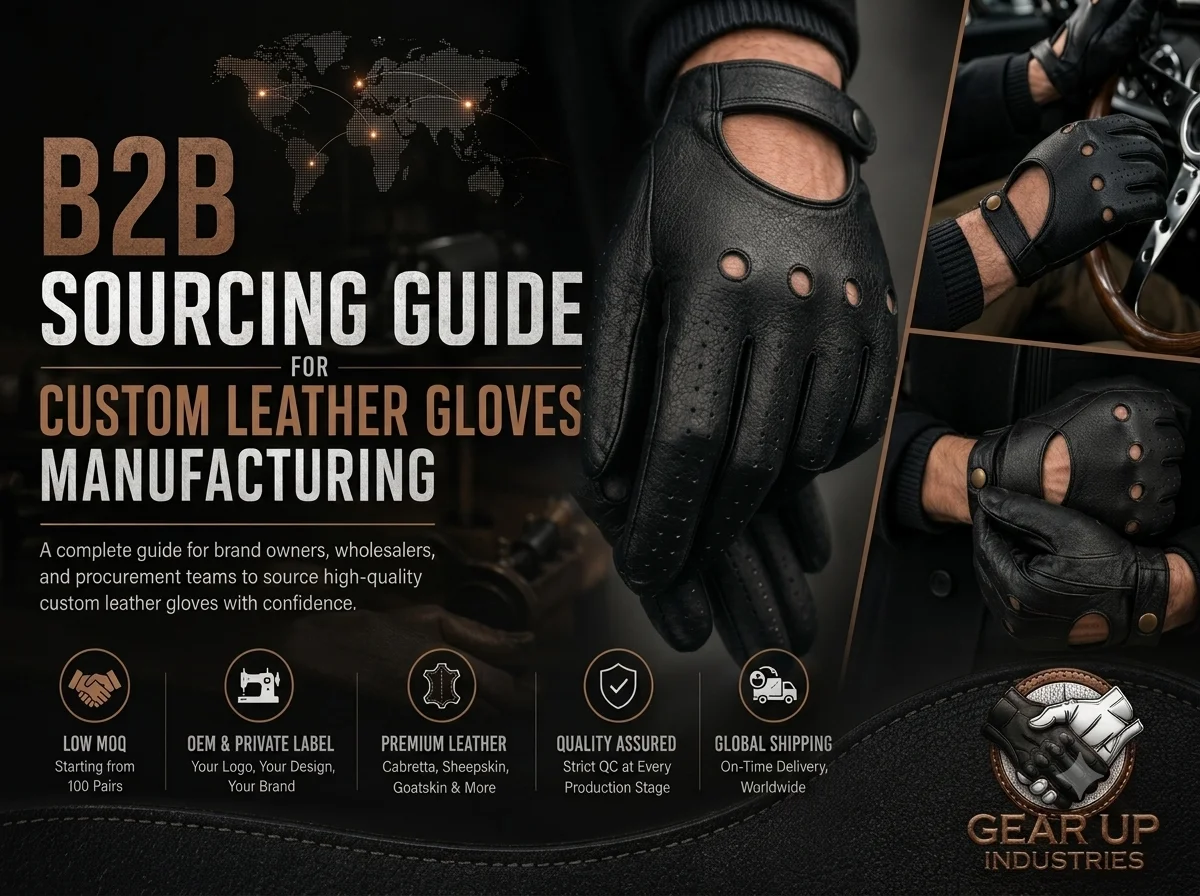
Sourcing custom leather gloves for a wholesale, retail, or private label business is a completely different exercise than buying a single finished pair online. A B2B buyer has to think about leather grading, minimum order quantities, sampling cycles, branding execution, shipping timelines, and most importantly, finding a manufacturer who won’t disappear after the deposit clears. Get any one of these wrong and you end up with delayed stock, inconsistent quality across batches, or a shipment of gloves that doesn’t reflect your brand at all.
This guide walks brand owners, wholesalers, distributors, and procurement teams through the entire sourcing process for custom leather hand gloves from defining specifications, to choosing between a factory, an agent, or a marketplace, right through to placing a bulk order with real confidence. Whether you’re building a golf glove line, a driving glove collection, or a private label accessory brand, the fundamentals of vetting a leather glove manufacturer stay the same.
Why B2B Buyers Are Rethinking Glove Sourcing in 2026
Global buyers are steadily moving away from generic marketplace listings and toward direct relationships with specialized factories. Rising freight costs, longer lead times from oversaturated sourcing regions, and inconsistent quality control from unverified sellers have pushed serious brands to look for manufacturers who offer transparency, realistic MOQs, and genuine OEM capability rather than a repackaged catalog item with a new label sewn in.
This shift also means buyers are doing more homework before they commit. Instead of sending a single “please quote” message and waiting, experienced procurement teams now check a supplier’s production history, request real physical samples, ask pointed questions about leather origin, and confirm stitching and finishing standards before signing off on any bulk leather gloves order. The buyers who skip this stage are, almost without exception, the ones who end up posting complaints about missed deadlines and mismatched quality months later.
Another factor driving this shift is the growth of private label fashion and sports accessory brands that simply didn’t exist a few years ago. These smaller, agile brands don’t have in-house sourcing teams, so they lean heavily on manufacturers who can guide them through specifications, MOQ, and customization rather than just taking an order and shipping a box.
Step 1: Define Your Product Specifications Before You Search
The single biggest mistake new B2B buyers make is reaching out to suppliers before they actually know what they need. A vague inquiry gets a vague quote, and a vague quote almost never matches the final invoice once real production numbers come in.
Glove Category and End-Use
Decide the category first: golf gloves, driving gloves, fashion gloves, or industrial work gloves. Each category uses different leather weights, stitching patterns, panel construction, and finishing techniques, so a factory that excels at one category may not be the right fit for another. A manufacturer that’s excellent at rugged work gloves, for instance, may not have the pattern-cutting finesse required for a tight-fitting driving glove.
Leather Type and Grade
Cabretta, sheepskin, goatskin, and cowhide all behave very differently in terms of softness, grip, breathability, and long-term durability. Decide early whether your target market values a premium, buttery hand-feel, where cabretta or sheep leather usually wins or rugged, cost-efficient durability, where goat or cowhide tends to perform better over repeated use.
Sizing, Fit, and Closure Style
Buyers frequently overlook sizing standardization until it becomes a customer complaint. Decide upfront whether you need a unisex size run, separate men’s and women’s fits, or a single standardized size chart across all SKUs, and specify closure preferences (Velcro tab, snap button, elastic wrist, or fitted cuff) before requesting a quote.
Step 2: Direct Factory vs Sourcing Agents vs Marketplaces
There are three common routes into custom leather glove manufacturing, and each comes with its own trade-offs in cost, control, and communication speed.
Working With a Direct Manufacturer
Going straight to a factory removes a layer of commission, gives you direct control over specifications during sampling, and speeds up communication when revisions are needed. This is usually the preferred route for brands planning repeat orders or a long-term supply relationship, since every conversation happens with the people who actually cut and stitch the leather.
Sourcing Agents
Agents can be genuinely useful for buyers who are unfamiliar with a sourcing region or a specific product category, since they can vet factories on your behalf. However, they add a markup on top of the factory price and introduce an extra communication step between you and the production floor, which can slow down sample revisions and create room for miscommunication about specifications.
B2B Marketplaces
Platforms like Alibaba, Made-in-China, and regional B2B directories are useful for initial discovery and price benchmarking, but they carry a higher risk of reseller listings disguised as factories. It’s worth always verifying a marketplace supplier’s actual production facility, either through a factory audit, a video call walkthrough, or a physical visit, before placing any deposit.
Step 3: How to Evaluate a Leather Glove Manufacturer
Once you’ve shortlisted a few candidates, run them through a proper evaluation rather than picking based on price alone.
Manufacturing Experience and Specialization
Ask how long the factory has specifically focused on leather gloves, rather than leather goods in general. A manufacturer with years of dedicated glove-making experience will understand finger articulation, seam placement, and pattern grading far better than a general leather workshop that occasionally produces gloves as a side line.
MOQ Flexibility
Low minimum order quantities matter enormously for newer brands testing a product line before committing to a large inventory investment. A factory that offers realistic MOQs, rather than forcing a 1,000-plus unit commitment on a first order, signals genuine confidence in its own consistency and a willingness to build the relationship gradually.
OEM and Private Label Support
Confirm the manufacturer can handle full private labeling: your logo on the tab or cuff, your retail packaging, your size charts, and your specific color palette, rather than just a stock design with a sticker added on top.
Quality Control Process
Ask specifically how leather is inspected on arrival, how stitching consistency is checked during production, and whether a pre-shipment inspection report is provided before the container leaves the factory. A manufacturer that can’t clearly describe its own QC checkpoints usually doesn’t have one.
Communication and Responsiveness
How a supplier answers your initial questions is often the best predictor of how they’ll handle a production problem later. Slow, vague, or evasive replies during the inquiry stage rarely improve once money has changed hands.
Step 4: Understanding Cost Structure and MOQ
Pricing in bulk leather gloves sourcing depends on several stacked variables: leather grade, lining material, hardware (Velcro, snaps, or buttons), embroidery or logo application method, and total order volume. Buyers should request a tiered price breakdown across a few different quantities, say 100, 300, and 1,000 pairs, so they can see exactly where the per-unit cost drops, rather than negotiating blind on a single flat quote.
It’s also worth asking whether pricing is quoted FOB (Free on Board) from the factory’s port, or whether it includes freight to your destination, since this single detail changes the comparison between suppliers dramatically.
Step 5: Sampling Before Bulk Production
Never skip the sample stage, regardless of how confident a supplier sounds on a call. A pre-production sample confirms leather grade, stitching quality, sizing accuracy, and branding placement before you commit to hundreds or thousands of pairs. Reputable factories expect this step as standard practice and will typically produce a sample within one to two weeks of receiving final specifications.
If a supplier discourages sampling or pushes you straight to a large bulk order, treat that as a warning sign rather than a time-saving offer.
Step 6: Shipping, Lead Times, and Logistics
Air freight suits smaller, time-sensitive orders where speed matters more than cost, while sea freight is significantly more economical for large bulk shipments where a few extra weeks in transit is acceptable. Confirm Incoterms (FOB, CIF, or EXW) upfront in writing, and ask your manufacturer for a realistic production-plus-shipping timeline rather than a rough verbal estimate that tends to shift once production starts.
Buyers should also clarify who handles customs documentation on each end, since this is a common point of confusion between first-time importers and their factory.
Step 7: Building a Long-Term Sourcing Relationship
The most successful B2B partnerships in this industry aren’t purely transactional. Buyers who share seasonal forecasts in advance, give clear and timely feedback on samples, and maintain consistent communication typically get priority production slots and better pricing over time compared to buyers who place a single order and disappear until the next season.
Treating a manufacturer as a long-term partner rather than a one-time vendor also tends to pay off when urgent reorders or last-minute specification tweaks come up, since an established relationship carries a level of trust that a first-time inquiry simply doesn’t have.
Common Mistakes B2B Buyers Make When Sourcing Leather Gloves
- Choosing a supplier purely on the lowest quoted price without checking sample quality first
- Skipping a written agreement on lead times, along with any penalties for delays
- Not confirming leather origin or grade in writing before production begins
- Ignoring communication responsiveness during the inquiry stage, which often predicts how production issues will be handled later
- Underestimating how long customization (embroidery, packaging, tags) adds to the base production timeline
Why Sialkot, Pakistan Is a Strategic Sourcing Hub for Leather Gloves
Sialkot has been a center of leather glove and sports goods manufacturing for decades, with an established supply chain for raw hides, generations of skilled stitching labor, and export logistics infrastructure already in place. This concentration of expertise is a major reason why many international golf and driving glove brands source directly from the region rather than starting a supply chain from scratch elsewhere.
The density of tanneries, component suppliers, and experienced factories in one relatively compact industrial area also means shorter internal lead times between sourcing raw leather and finishing a completed order, compared to regions where these steps are spread across different provinces or countries.
How Gearup Industries Supports B2B Buyers
Gearup Industries, based in Sialkot, Pakistan, works directly with wholesalers, distributors, and private label brands sourcing custom leather golf gloves and leather driving gloves, including fingerless driving gloves and crochet-style driving gloves. The factory offers low MOQs starting at 100 pairs, full OEM and private label customization, sampling before any bulk production run, and direct factory pricing with no middleman markup added on top.
Frequently Asked Questions
What is a good MOQ for custom leather gloves?
Many established factories, including Gearup Industries, offer MOQs starting around 100 pairs per design, making it accessible for newer brands testing a product line before scaling into larger orders.
How long does bulk production typically take?
Standard production timelines for custom leather gloves generally range from three to six weeks, depending on order size, level of customization, and how many sample revisions are needed before final approval.
Should I always request a sample before placing a bulk order?
Yes. A pre-production sample is the only reliable way to confirm leather grade, stitching quality, and branding placement before committing to a full bulk order, and any manufacturer that discourages sampling should be treated with caution.
Is it better to work with a factory directly or through a sourcing agent?
Working directly with a manufacturer generally offers better pricing, faster communication, and more direct control over customization, though agents can still be useful for buyers who are unfamiliar with a particular sourcing region or product category.
What leather is best for custom gloves – cabretta, sheepskin, goatskin, or cowhide?
It depends on the end use: cabretta and sheepskin offer a softer, more premium hand-feel suited to fashion or golf gloves, while goatskin and cowhide tend to offer better durability for driving and heavier-use gloves.
Final Thoughts
Sourcing custom leather gloves at a B2B level comes down to preparation: know your exact specifications, evaluate manufacturers on more than price alone, insist on a proper sampling stage, and build the kind of relationship that survives beyond a single order. Buyers who follow this process consistently end up with better and more consistent quality, fewer production delays, and pricing that improves naturally as the relationship matures over multiple seasons.
If you’re currently evaluating manufacturers for your next bulk order, contact Gearup Industries directly for a quote, current MOQ details, and sample availability.