

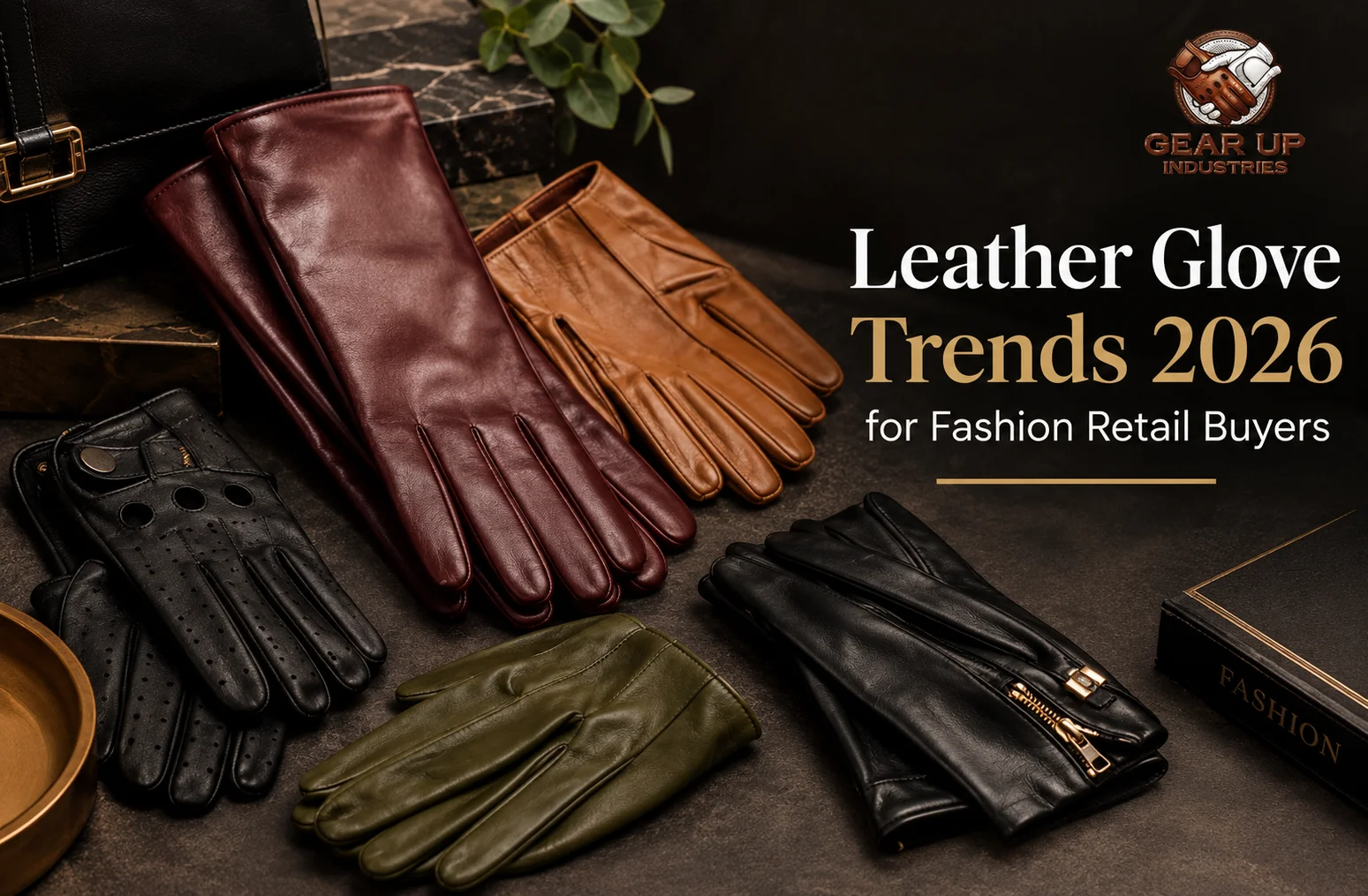
For fashion retailers in the USA and other established fashion markets, leather gloves are becoming more than a seasonal cold-weather accessory. In 2026, gloves are increasingly being treated as part of the overall outfit, with runway and street-style coverage showing leather and elongated glove styles used as deliberate fashion statements.
For buyers, this shift creates opportunities to build glove collections around color, silhouette, leather finish, construction, and styling rather than relying only on traditional black winter gloves.
However, following a trend does not mean ordering every fashion-forward style available. Retail buyers need to consider product positioning, target customer, price point, sizing, leather selection, packaging, and expected sell-through before committing to a bulk order.
This guide covers the key leather glove trends for 2026 and explains what fashion retail buyers should consider when developing or sourcing a new collection.
What Are Driving Leather Glove Trends in 2026?
The most noticeable change is that gloves are increasingly being treated as a visible styling element.
Fashion coverage for Spring/Summer 2026 has highlighted gloves across multiple runway collections, including leather, lace, sequins, sheer materials, and shorter silhouettes. Vogue has also identified colorful, above-the-elbow leather gloves as an emerging statement accessory, while Milan street style has shown shorter leather gloves being worn as finishing pieces rather than simply for warmth.
For retailers, this means the category can be approached from several directions:
- Classic leather accessories
- Driving-inspired fashion gloves
- Short everyday leather gloves
- Statement long gloves
- Vintage-inspired styles
- Minimalist premium designs
- Color-focused seasonal collections
From Functional Product to Styling Accessory
The shift matters because it changes how a retailer may merchandise gloves.
A traditional winter glove is usually purchased around weather and warmth. A fashion-oriented glove can instead be purchased to complement:
- Tailored coats
- Leather jackets
- Dresses
- Knitwear
- Eveningwear
- Denim
- Vintage-inspired outfits
- Automotive-inspired fashion
That gives retailers more opportunities to use gloves across different product categories.
1. Short Leather Gloves With a Clean, Minimal Shape
One of the most commercially useful directions for 2026 is the short leather glove.
Unlike long opera-length styles, short gloves are easier to integrate into everyday wardrobes. They can be worn with coats, blazers, leather jackets, tailored clothing, and casual outfits.
For retailers, this makes short leather gloves worth considering as a core collection rather than only as a seasonal statement piece.
Why Short Gloves Can Work for Retail Collections
A shorter silhouette can offer several merchandising advantages:
- Easier styling across multiple seasons
- Less dramatic than long fashion gloves
- Suitable for classic and contemporary collections
- Compatible with driving-inspired designs
- Easier to position as an everyday accessory
For a new brand, a compact leather glove range can also be easier to test than a large collection containing many highly specialized silhouettes.
2. Longer Leather Gloves as Statement Pieces
Long gloves are one of the more visible fashion directions in 2026.
Current fashion coverage has highlighted opera-length and above-the-elbow gloves across runway and editorial styling. Vogue Arabia reported leather glove variations at Balenciaga, while ELLE has covered the renewed popularity of long gloves in leather and other materials.
For fashion retailers, long leather gloves can serve a different purpose from everyday driving or winter styles.
Where Long Gloves Fit in a Retail Assortment
Long styles can work particularly well as:
- Statement accessories
- Occasionwear pieces
- Evening fashion accessories
- Premium capsule products
- Limited seasonal collections
- Editorial or campaign products
Retailers should be more selective with sizing and production quantities for highly fashion-driven silhouettes because their commercial life may be narrower than a classic short glove.
3. Richer Colors Beyond Traditional Black and Brown
Black and brown remain important foundation colors for leather accessories, but 2026 fashion coverage is showing greater interest in expressive color.
Recent reporting has highlighted shades such as teal, magenta, turquoise, plum, sky blue, and other contrasting tones in glove styling.
For a retail buyer, the opportunity is not necessarily to replace neutral colors.
Instead, consider building a color architecture.
Build a Core-and-Accent Color Strategy
A practical collection might include:
| Collection Role | Possible Direction |
| Core | Black |
| Core | Dark brown |
| Seasonal neutral | Chocolate or taupe |
| Fashion accent | Deep plum |
| Fashion accent | Teal or blue |
| Statement | Red or another strong seasonal color |
This gives retailers recognizable commercial basics while creating room for trend-led products.
Why Color Selection Matters in Leather
Leather does not always reproduce color in exactly the same visual way as synthetic materials.
The final appearance can be influenced by:
- Leather type
- Surface finish
- Dyeing process
- Grain
- Texture
- Lighting
- Product construction
Retail buyers should therefore approve physical samples before committing to large quantities of fashion colors.
4. Soft, Close-Fitting Leather That Works With Tailoring
Another direction worth watching is the close-fitting leather glove that works almost like a second skin.
Milan Fashion Week street style coverage in 2026 specifically highlighted soft leather gloves and longer silhouettes being used as styling elements with tailoring and coats.
This creates a useful opportunity for retailers selling premium accessories.
A slim glove can complement structured clothing without adding visual bulk.
Material Selection Becomes More Important
For close-fitting styles, leather selection and sizing become particularly important.
The buyer should consider:
- Hand feel
- Flexibility
- Thickness
- Grain consistency
- Stretch requirements
- Seam placement
- Size grading
Retail brands researching leather options can also review the differences between sheepskin and goatskin for custom bulk gloves when deciding which material characteristics fit a particular collection.
5. Vintage-Inspired Leather Glove Details
Heritage styling continues to influence accessories, and gloves are particularly suited to vintage references.
Retail buyers can interpret the look through details such as:
- Perforated leather
- Contrast stitching
- Snap closures
- Button details
- Decorative seams
- Classic wrist shapes
- Unlined construction
- Retro driving-glove references
The important distinction is between vintage inspiration and simply reproducing an old product.
A modern retailer can use historical details while adjusting the silhouette, colors, leather, and branding for today’s customer.
Driving Gloves as a Fashion Reference
Driving gloves provide a useful design language for fashion retailers because they combine recognizable heritage styling with an accessory-oriented appearance.
Retailers considering this direction can explore both traditional and contemporary styles rather than treating driving gloves as a separate automotive-only category.
For brands developing this category, Gearup Industries guide on vintage vs. modern driving gloves can help frame the design differences before moving into product development.
6. Fingerless and Open-Hand Styles
Fingerless gloves continue to provide another route for fashion retailers looking for a more distinctive accessory.
They can create a different visual proportion from traditional full-finger gloves and can work with fashion, automotive, lifestyle, and streetwear concepts.
Where Fingerless Gloves Can Fit
Depending on the design, they can be positioned as:
- Fashion accessories
- Driving-inspired accessories
- Transitional-season products
- Layering pieces
- Alternative styles within a leather collection
Retail buyers should be clear about whether the product is being positioned primarily as fashion, function, or a combination of both.
For brands considering this category, the difference between fingerless and full-finger construction is important when planning a collection.
7. Crochet-Back and Mixed-Material Leather Styles
Fashion retailers do not necessarily need to choose between a completely traditional leather glove and a highly experimental fashion glove.
Mixed-material construction can create visual contrast while maintaining a recognizable leather base.
Crochet-back leather driving gloves are one example.
The combination of leather and crochet creates a different texture and appearance from an all-leather glove, making the style suitable for brands that want heritage character with a lighter visual feel.
Current fashion coverage also points to a broader interest in texture and tactile elements across 2026 fashion collections, making material contrast relevant when developing accessory collections.
8. Statement Details Instead of Overly Complicated Designs
Not every trend-led glove needs an unusual silhouette.
A retailer can create a fashion-forward product through one carefully selected detail.
Examples include:
- Contrast stitching
- Perforation
- Decorative buttons
- Unusual cuff construction
- Small metal details
- Two-tone leather
- Embossed branding
- Distinctive wrist closures
This can be a useful strategy for brands that want to introduce trend-sensitive products without completely changing their existing product architecture.
Use Details to Create Product Differentiation
A small design change can create a separate SKU without requiring an entirely new glove concept.
For example, the same general silhouette could be offered in:
- Classic black
- Brown with contrast stitching
- Seasonal color
- Perforated leather
- Embossed branding
This approach can help a retail buyer build variety while maintaining a coherent collection.
9. Tactile Leather and Visible Craftsmanship
Texture is becoming increasingly important in fashion retail.
FashionUnited’s 2026 trend reporting points to textured products and tactile experiences as an important part of the season’s retail direction.
Leather naturally provides an opportunity here because buyers can differentiate products through:
- Grain
- Finish
- Softness
- Matte versus polished appearance
- Perforation
- Stitching
- Surface texture
Show the Leather Rather Than Hiding It
For premium leather accessories, the material itself can be part of the product story.
This is one reason packaging and merchandising should be considered during product development. A package that completely hides the glove may not take advantage of the visual quality of the leather.
For retail brands, a window box, sleeve, hangtag, or carefully designed display format can allow the material and construction to remain visible.
10. More Personal and Expressive Glove Collections
Another 2026 direction is the movement toward accessories that communicate individual style.
Vogue’s 2026 trend coverage describes a broader fashion movement toward expressive “personality pieces,” while current glove coverage similarly frames gloves as styling accessories rather than purely functional products.
For retailers, this can mean offering a collection with different personalities instead of one generic glove design.
For example:
Classic:
Black or dark brown, clean stitching, minimal branding.
Heritage:
Vintage driving details, perforations, traditional construction.
Modern:
Clean silhouette, unexpected color, subtle branding.
Statement:
Longer silhouette, stronger color, or distinctive detailing.
What Fashion Retail Buyers Should Consider Before Ordering
Trends can create demand, but wholesale buyers still need to evaluate the commercial side of the product.
1. Expected Selling Price
A more complex glove may require additional materials, labor, sampling, and packaging.
Before approving a design, work backward from your expected retail price and target margin.
Balance Product Cost With Retail Positioning
The packaging, leather, construction, and finishing should support the price point you plan to offer to customers.
Calculate the Full Product Cost
Consider the glove itself, customization, packaging, sampling, shipping, and other sourcing expenses when evaluating the expected margin.
Leave Room for Seasonal Pricing
Fashion retailers may need flexibility for promotions, markdowns, or end-of-season sales, so the original product cost should leave sufficient room for retail adjustments.
2. Size Range
A trend-driven style still needs a practical size strategy.
If the collection targets both men’s and women’s customers, do not assume the same grading approach will work for both.
Sizing should be tested on physical samples before bulk production.
3. Leather Selection
The leather should support the intended style.
A soft, close-fitting fashion glove may require different characteristics from a structured heritage-style driving glove.
The same applies to thickness.
Retail buyers developing driving-inspired collections can review the leather thickness guide for driving gloves when evaluating tactile feel, flexibility, and product construction.
4. Stitching and Construction
Visible stitching can become a design element, but it also has to work as part of the glove’s construction.
Seam placement, stitch density, reinforcement, and overall workmanship should be reviewed during sampling.
How to Turn 2026 Trends Into a Retail Collection
Retailers should avoid building an assortment entirely around short-lived trends.
A better approach is to combine established silhouettes with a smaller number of trend-led products.
Use a Core + Trend Collection Model
A practical structure could look like this:
| Collection | Purpose | Example |
| Core | Consistent year-round style | Black leather glove |
| Heritage | Classic identity | Perforated driving glove |
| Seasonal | Color update | Deep seasonal shade |
| Fashion | Trend-led statement | Longer leather glove |
| Experimental | Limited test | Unusual construction or detail |
This allows buyers to test fashion trends without making the entire inventory dependent on one aesthetic direction.
Start With Samples Before Bulk Production
Before committing to a larger quantity, request samples of the designs that are most important to the collection.
Review:
- Leather quality
- Color
- Fit
- Construction
- Stitching
- Logo placement
- Packaging
- Overall retail appearance
This is especially important when introducing an unfamiliar silhouette.
For a broader sourcing framework, buyers can also review the B2B Sourcing Guide for Custom Leather Gloves Manufacturing before finalizing specifications.
How Private-Label Brands Can Use 2026 Trends
Private-label manufacturing gives fashion retailers an opportunity to translate a trend into a product that matches their own brand identity.
Instead of copying a runway style directly, a retailer can adapt the broader direction through:
- Color
- Leather
- Length
- Cuff design
- Stitching
- Branding
- Packaging
- Size range
Keep the Brand Identity Strong
A trend should support the brand rather than replace it.
For example, a heritage accessories brand might interpret the 2026 glove trend through classic driving details, while a contemporary fashion label might choose a cleaner silhouette and stronger color.
This is where OEM and private-label development becomes useful because the product can be developed around the retailer’s specific concept.
2026 Leather Glove Trend Checklist for Retail Buyers
Before placing a bulk order, review each proposed style against these questions:
- Does the design fit the brand’s existing aesthetic?
- Is the trend likely to work with the target customer?
- Is the leather appropriate for the intended construction?
- Is the color commercially realistic?
- Has the sizing been physically tested?
- Is the stitching suitable for the design?
- Can the style be produced consistently?
- Does the packaging match the product positioning?
- Is the MOQ appropriate for the planned collection?
- Has a physical sample been approved?
- Can the product be differentiated from competing retail offerings?
If several answers are uncertain, the design may need another development round before bulk production.
Frequently Asked Questions
What are the biggest leather glove trends for 2026?
Key directions include gloves being used as fashion accessories rather than only functional winter products, along with short leather styles, longer statement gloves, expressive colors, vintage references, and distinctive construction details.
Are leather gloves becoming a fashion accessory in 2026?
Yes. Current runway and street-style coverage shows gloves being styled as part of complete outfits, including with tailoring, coats, and evening looks.
Should fashion retailers focus only on trendy glove styles?
No. A balanced assortment can combine established core styles with a smaller selection of trend-led products. This allows buyers to test new directions without making the entire collection dependent on one trend.
Which leather colors should retail buyers consider for 2026?
Black and brown remain useful foundation colors, while current fashion coverage has also highlighted more expressive shades such as teal, plum, turquoise, and other stronger tones.
Are long leather gloves suitable for retail collections?
They can work as statement or occasion-oriented products. However, buyers should evaluate the intended customer, season, sizing requirements, and expected sales volume before placing a large order.
How can private-label brands use fashion trends without copying runway products?
Brands can interpret broader trends through their own leather selection, colors, silhouettes, stitching, cuff details, branding, and packaging rather than reproducing a specific designer product.
Should retailers order samples before bulk leather glove production?
Yes. Physical samples allow buyers to evaluate leather, fit, color, construction, branding, and overall product appearance before committing to larger quantities.
Conclusion
The 2026 glove market offers fashion retailers more possibilities than a simple selection of black and brown winter gloves.
Current fashion coverage points toward gloves becoming more visible as styling pieces, with leather, longer silhouettes, expressive colors, tactile materials, and vintage references appearing across runway and street-style conversations.
For fashion buyers in the USA and other international retail markets, the opportunity is to translate these trends into commercially realistic products rather than chasing every short-term fashion signal.
A strong collection can combine dependable leather glove silhouettes with carefully selected trend-led styles, supported by the right leather, sizing, construction, branding, packaging, and production strategy.
For brands developing private-label collections, Gearup Industries can support the product-development process from glove specifications and sampling through customized manufacturing requirements. The key is to treat the trend as a starting point for product development, not as a substitute for careful sourcing and retail planning.