

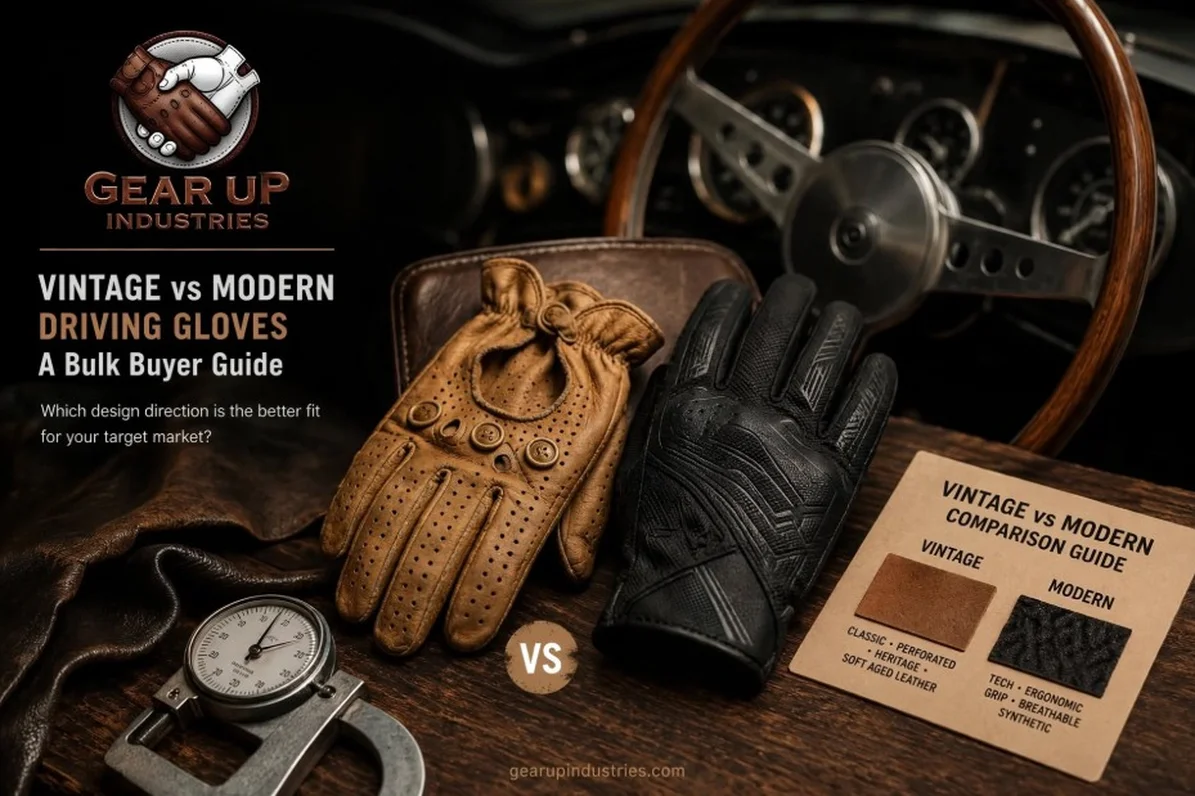
When sourcing leather driving gloves in bulk, the decision between a vintage-inspired design and a modern ergonomic construction affects far more than the product’s appearance.
For automotive brands, wholesalers, distributors, car clubs, retailers, and private-label businesses, the glove needs to match the intended customer, brand positioning, price point, and sales channel. Leather selection, pattern construction, grip, stitching, sizing, logo placement, and packaging all need to work together.
So, Vintage vs Modern Driving Gloves should not be treated as a simple style comparison.
The more important B2B question is:
Which design direction is the better fit for your target market and bulk product strategy?
Vintage designs typically emphasize traditional automotive styling, classic leather character, perforations, and heritage details. Modern ergonomic designs focus more heavily on hand movement, fit, flexibility, grip, and contemporary product aesthetics.
Both approaches can work for wholesale and private-label programs. The right choice depends on how the finished glove will be positioned in the market.
What Is the Difference Between Vintage and Modern Driving Gloves?
The biggest difference is the priority behind the design.
Vintage driving gloves are generally developed around the visual language of classic motoring. Modern ergonomic driving gloves place greater emphasis on contemporary construction, hand movement, fit, and functional details.
| Feature | Vintage Driving Gloves | Modern Ergonomic Driving Gloves |
| Primary design focus | Heritage and classic styling | Fit and functional construction |
| Appearance | Traditional and refined | Contemporary and technical |
| Pattern approach | Classic glove construction | Hand-shaped ergonomic construction |
| Leather emphasis | Character and traditional appearance | Consistency, flexibility, and performance |
| Branding | Understated or heritage-inspired | Contemporary and adaptable |
| Typical buyers | Classic-car brands, clubs, collectors | Automotive lifestyle and performance brands |
| Merchandise use | Heritage collections and events | Modern retail and lifestyle collections |
| Customization | High | High |
Neither design is automatically better.
A B2B buyer should select the construction based on the product’s intended market rather than choosing a style simply because it looks attractive in a catalog.
What Defines a Vintage Driving Glove?
Vintage driving gloves are closely associated with classic motoring culture.
Common visual characteristics can include perforated leather, traditional cuffs, contrast stitching, open-back details, button closures, and classic leather colors.
Why Brands Choose Vintage Driving Gloves
Vintage styling can be particularly appropriate for:
- Classic-car clubs
- Collector-car businesses
- Heritage automotive brands
- Motorsport heritage programs
- Vintage driving events
- Luxury automotive merchandise
- Automotive lifestyle retailers
The appeal comes from the connection between the product and the history of driving.
A well-designed vintage glove can therefore become more than an accessory. It can become part of a brand’s storytelling.
Vintage Styling as a Merchandise Strategy
For a car club or automotive brand, the vintage look can complement an existing merchandise collection.
For example, a brand selling classic vehicle accessories may combine driving gloves with leather wallets, caps, jackets, bags, or other automotive lifestyle products.
The glove should visually belong to that collection.
Leather Character Is Part of the Vintage Look
The leather itself plays an important role in creating the desired heritage appearance.
Buyers should evaluate:
- Surface character
- Grain
- Flexibility
- Thickness
- Finish
- Color
- Consistency
A vintage-inspired product does not necessarily require leather with excessive variation. Instead, the material should have a character that supports the intended brand positioning.
Avoid Choosing Leather From Appearance Alone
A leather may look excellent in photographs but behave differently during cutting, stitching, and glove assembly.
For bulk manufacturing, leather should be evaluated for both appearance and suitability for the selected glove pattern.
What Makes Modern Driving Gloves Ergonomic?
Modern ergonomic driving gloves are developed with greater attention to the relationship between the glove and natural hand movement.
The design can consider finger shape, thumb position, palm construction, wrist movement, and seam placement.
Ergonomic Pattern Construction
A modern glove pattern may be developed to follow the natural shape of the hand more closely.
Important considerations include:
- Finger length
- Thumb angle
- Palm width
- Wrist construction
- Seam location
- Flexibility
- Overall hand movement
For B2B buyers, these details can have a direct effect on perceived product quality.
Why Fit Matters in a Modern Glove
A modern ergonomic design should not only look contemporary.
The customer needs to be able to move the hand naturally while wearing the product.
This makes physical sampling particularly important.
Evaluate the Glove in a Natural Driving Position
A glove should be assessed while the hand is positioned as it would be during driving.
Check how the fingers bend, how the thumb moves, and whether the palm stays correctly positioned.
Test Movement Before Bulk Approval
Before approving production, buyers should evaluate:
- Finger movement
- Thumb flexibility
- Palm contact
- Wrist movement
- Seam pressure
- Overall fit
These checks can reveal issues that are difficult to identify from a digital design or product photograph.
Vintage vs Modern Driving Gloves: Which Is Better for Bulk Buyers?
There is no universal winner.
The appropriate design depends on the commercial purpose of the product.
When Vintage Driving Gloves Make More Sense
Choose a vintage-inspired direction when the brand is built around:
- Automotive heritage
- Classic vehicles
- Collector culture
- Traditional craftsmanship
- Luxury nostalgia
- Heritage motorsport
Vintage styling can be particularly effective for limited-edition merchandise and automotive events.
For brands exploring this product direction, the Leather Driving Gloves category can be used as a starting point for evaluating traditional leather glove constructions.
When Modern Ergonomic Gloves Make More Sense
Modern construction can be more appropriate when the product is positioned around:
- Performance
- Contemporary automotive culture
- Modern luxury
- Functional design
- Ergonomics
- Lifestyle branding
A modern glove may also fit more naturally into a broader collection of contemporary automotive accessories.
When a Hybrid Design Is the Better Choice
The decision does not always need to be vintage versus modern.
A hybrid product can combine:
- Traditional leather
- Vintage-inspired perforations
- Modern ergonomic patterning
- Contemporary grip construction
- Refined branding
- Updated cuff design
This approach can be particularly useful for brands that want heritage appeal without making the product feel outdated.
Leather Selection for Vintage and Modern Driving Gloves
Leather selection should be connected to the product’s intended construction and market positioning.
Leather Considerations for Vintage Designs
Vintage products often benefit from leather that provides a refined, traditional appearance.
Depending on the required specification, buyers may evaluate sheep, goat, buffalo, or other suitable leather options.
The key factors include:
- Softness
- Flexibility
- Grain
- Thickness
- Surface finish
- Color consistency
Leather Considerations for Modern Designs
Modern ergonomic gloves may place greater emphasis on consistency and flexibility because the leather needs to work with a more deliberately shaped pattern.
The selected material should support the intended construction without compromising fit or appearance.
Buffalo, Sheep, and Goat Leather Should Not Be Treated as Identical
Different leather types can produce different characteristics.
For example, buyers may evaluate:
| Leather consideration | Why it matters |
| Softness | Influences hand feel |
| Thickness | Affects construction and flexibility |
| Grain | Influences appearance |
| Flexibility | Important for hand movement |
| Consistency | Important for bulk production |
| Finish | Influences brand positioning |
The correct choice depends on the glove specification rather than a simple ranking of leather types.
Grip Construction in Bulk Driving Gloves
Grip is an important consideration when developing a glove intended for driving-related use.
Vintage Grip Approach
Traditional leather driving gloves can rely heavily on the leather’s natural surface and construction.
The design may emphasize simplicity rather than visibly technical grip zones.
Modern Grip Approach
Modern designs may incorporate more deliberate palm construction and reinforcement.
The manufacturer can evaluate:
- Palm leather
- Surface texture
- Reinforcement areas
- Seam positioning
- Grip zones
- Pattern construction
Grip and Fit Need to Work Together
A glove can have an appropriate palm construction but still feel unstable if the fit is incorrect.
For this reason, buyers should assess grip and fit together during sampling.
Sizing Considerations for Bulk Driving Gloves
Sizing can become a major issue when gloves are sold through wholesale, retail, or private-label channels.
A product that looks excellent but has inconsistent sizing can create unnecessary returns and customer complaints.
Men’s and Women’s Sizing
Brands selling to mixed audiences should establish their size range before production.
Do not assume that a single size distribution will work equally well for every customer group.
Planning the Size Curve
For established brands, previous sales data can help determine which sizes should receive greater inventory allocation.
For a new product, buyers can use:
- Customer surveys
- Pre-orders
- Existing accessory sales
- Retailer feedback
- Market testing
Do Not Automatically Divide the Order Equally
If a buyer orders 100 pairs, dividing the quantity equally between every available size may not reflect actual demand.
A practical size curve should be based on the expected customer profile.
Customization Options for Vintage and Modern Driving Gloves
Both design directions can support custom branding.
Logo Customization
Depending on the construction, branding options may include:
- Embossed logos
- Debossed logos
- Printed branding
- Custom labels
- Cuff branding
- Packaging branding
Vintage brands may prefer a subtle logo treatment, while modern automotive brands may use more visible branding.
Custom Color Development
Color is another way to distinguish a private-label glove.
Options may include:
- Brand colors
- Contrast stitching
- Two-tone leather
- Event-specific colors
- Limited-edition combinations
The selected colors should be evaluated during sampling because leather and stitching can affect the final appearance.
Custom Packaging
Packaging can turn a manufactured glove into a more complete retail product.
A buyer may develop:
- Custom boxes
- Sleeves
- Inserts
- Labels
- Hangtags
- Product information cards
For automotive retailers and private-label brands, packaging can also help establish a consistent presentation across the merchandise range.
Bulk Manufacturing and MOQ Considerations
Choosing a design is only the beginning of the sourcing process.
A manufacturer needs a clear specification before production can be evaluated accurately.
MOQ for Custom Driving Gloves
Gearup Industries‘ MOQ starts from 100 pairs per design.
This can provide a practical starting quantity for smaller automotive brands, car clubs, retailers, and private-label businesses testing a new product.
However, quantity should always be planned according to the sales model.
| Buyer type | Quantity planning consideration |
| Car club | Member demand and event sales |
| Automotive retailer | Store demand |
| Distributor | Customer accounts |
| Private-label startup | Initial market test |
| Established brand | Historical sales |
| Event organizer | Expected attendance and conversion |
Sampling Before Bulk Production
Sampling is one of the most important stages of custom glove development.
Before bulk approval, buyers should check:
- Leather
- Color
- Pattern
- Fit
- Stitching
- Grip
- Logo placement
- Logo execution
- Cuff construction
- Packaging
A sample should be treated as a product-development tool, not merely a visual preview.
Vintage vs Modern Driving Gloves for Different International Markets
The ideal design can vary according to brand positioning and customer expectations.
United States
The US market includes classic-car communities, motorsport enthusiasts, automotive lifestyle brands, dealerships, and specialty retailers.
Vintage gloves can work well for heritage-focused merchandise, while modern ergonomic designs may suit performance-oriented automotive brands.
United Kingdom
The UK’s strong classic-car and heritage motoring culture creates opportunities for traditional leather driving gloves.
Vintage styling can work particularly well for collector communities and heritage-focused merchandise programs.
Canada
Canadian buyers should consider seasonal purchasing patterns when planning inventory.
The timing of launches and event merchandise can influence how much stock should be ordered initially.
Germany and Wider Europe
European automotive markets contain both heritage and contemporary performance segments.
For B2B buyers, product consistency, sizing, finish, packaging, and clear specifications should be considered alongside visual design.
UAE
Premium automotive communities in the UAE can provide opportunities for higher-end branded accessories.
For warmer conditions, buyers may evaluate lighter constructions or breathable design features where appropriate.
Australia and New Zealand
Automotive lifestyle brands, touring groups, classic-car communities, and enthusiast events can all provide potential applications.
The appropriate glove should be selected according to the intended season, audience, and product positioning.
How to Choose Between Vintage and Modern Driving Gloves
A structured evaluation can make the decision easier.
Step 1 — Define the Brand Position
Ask whether the brand is communicating:
- Heritage
- Luxury
- Performance
- Modern design
- Automotive lifestyle
- Collector appeal
Step 2 — Define the Customer
Identify whether the primary customer is:
- Classic-car enthusiast
- Performance driver
- Automotive collector
- Retail customer
- Club member
- Lifestyle consumer
This keeps the product decision connected to commercial demand.
Step 3 — Select the Glove Construction
Compare full-finger, fingerless, and crochet-back options according to the intended brand identity.
For example, buyers interested in a more heritage-oriented product can evaluate Fingerless Leather Driving Gloves as one possible direction.
Step 4 — Develop the Sample
Confirm:
- Leather
- Fit
- Pattern
- Grip
- Stitching
- Logo
- Color
- Packaging
Step 5 — Approve the Production Specification
Once the sample is accepted, document the approved requirements so future production can follow the same specification.
For buyers new to custom glove sourcing, the B2B Sourcing Guide for Custom Leather Gloves Manufacturing provides a useful framework for approaching the broader manufacturing process.
Wholesale vs Private-Label Driving Gloves
The purchasing model should match the level of customization required.
Wholesale or Bulk Supply
Bulk purchasing generally works when a buyer selects an established glove style and orders it in quantity.
Customization may still include selected branding, colors, or packaging depending on the project.
Private-Label Manufacturing
Private-label production is more appropriate when the buyer wants the glove developed around its own brand specifications.
This can involve:
- Leather selection
- Product construction
- Color
- Logo
- Sizing
- Packaging
- Labels
- Other approved design details
Gearup Industries works with international B2B buyers looking for leather glove manufacturing, wholesale supply, and private-label production.
How to Brief a Driving Glove Manufacturer
A detailed manufacturing brief can reduce unnecessary revisions.
Information to Include
Send the manufacturer:
- Preferred design direction
- Glove style
- Reference photographs
- Leather preference
- Color requirements
- Logo artwork
- Logo placement
- Size range
- Estimated quantity
- Packaging requirements
- Target market
- Intended sales channel
Questions to Ask During Product Development
Ask:
- Is the selected leather suitable for the construction?
- Is the pattern appropriate for the intended fit?
- Can the logo be reproduced accurately?
- Is the requested color practical?
- How should the size range be structured?
- Does the sample require pattern adjustments?
- Can the approved specification be maintained for repeat orders?
For brands ready to discuss a specific project, the Gearup Industries contact page is the appropriate next step for submitting the product requirements.
Frequently Asked Questions
What is the main difference between vintage and modern driving gloves?
Vintage driving gloves emphasize classic automotive styling and heritage details, while modern ergonomic driving gloves place greater emphasis on contemporary construction, fit, flexibility, and hand movement.
Are vintage driving gloves better than modern driving gloves?
Neither is universally better. The correct choice depends on the target customer, brand identity, intended use, and sales channel.
Which style is better for a private-label driving glove brand?
Both can work. Vintage styles suit heritage and classic automotive brands, while modern ergonomic designs can suit contemporary performance and automotive lifestyle brands.
Can a manufacturer combine vintage styling with modern ergonomic construction?
Yes. A glove can combine traditional leather and vintage-inspired details with a contemporary ergonomic pattern, updated fit, or modern grip construction.
What leather is suitable for bulk driving gloves?
The appropriate leather depends on the construction and positioning of the glove. Buyers can evaluate sheep, goat, buffalo, and other suitable leather options according to flexibility, thickness, grain, finish, and consistency.
What is Gearup Industries’ MOQ for driving gloves?
Gearup Industries’ MOQ starts from 100 pairs per design. The final requirements should be confirmed according to the selected product and customization specifications.
Should I approve a sample before placing a bulk order?
Yes. A sample allows the buyer to evaluate leather, fit, sizing, stitching, grip, branding, color, and overall construction before bulk manufacturing.
Can I sell both vintage and modern driving gloves under one brand?
Yes. A brand can create separate collections for different customer segments—for example, a heritage collection for classic-car enthusiasts and a modern collection for performance-oriented customers.
Final Decision: Vintage, Modern, or Hybrid?
The best choice depends on the brand rather than on a universal definition of quality.
Choose vintage when heritage, classic motoring, collector appeal, and traditional leather aesthetics are central to the product.
Choose modern ergonomic when contemporary design, hand movement, fit, flexibility, and performance-oriented positioning are more important.
Choose hybrid when the brand wants classic automotive character combined with updated construction.
For B2B buyers, the most reliable process is to define the customer first, select the design direction second, develop a physical sample third, and only then approve the bulk manufacturing specification.
The objective is not simply to produce a glove that looks vintage or modern.
The objective is to produce a commercially appropriate driving glove that can be manufactured consistently, positioned clearly, and sold successfully through the intended wholesale, retail, club, or private-label channel.