

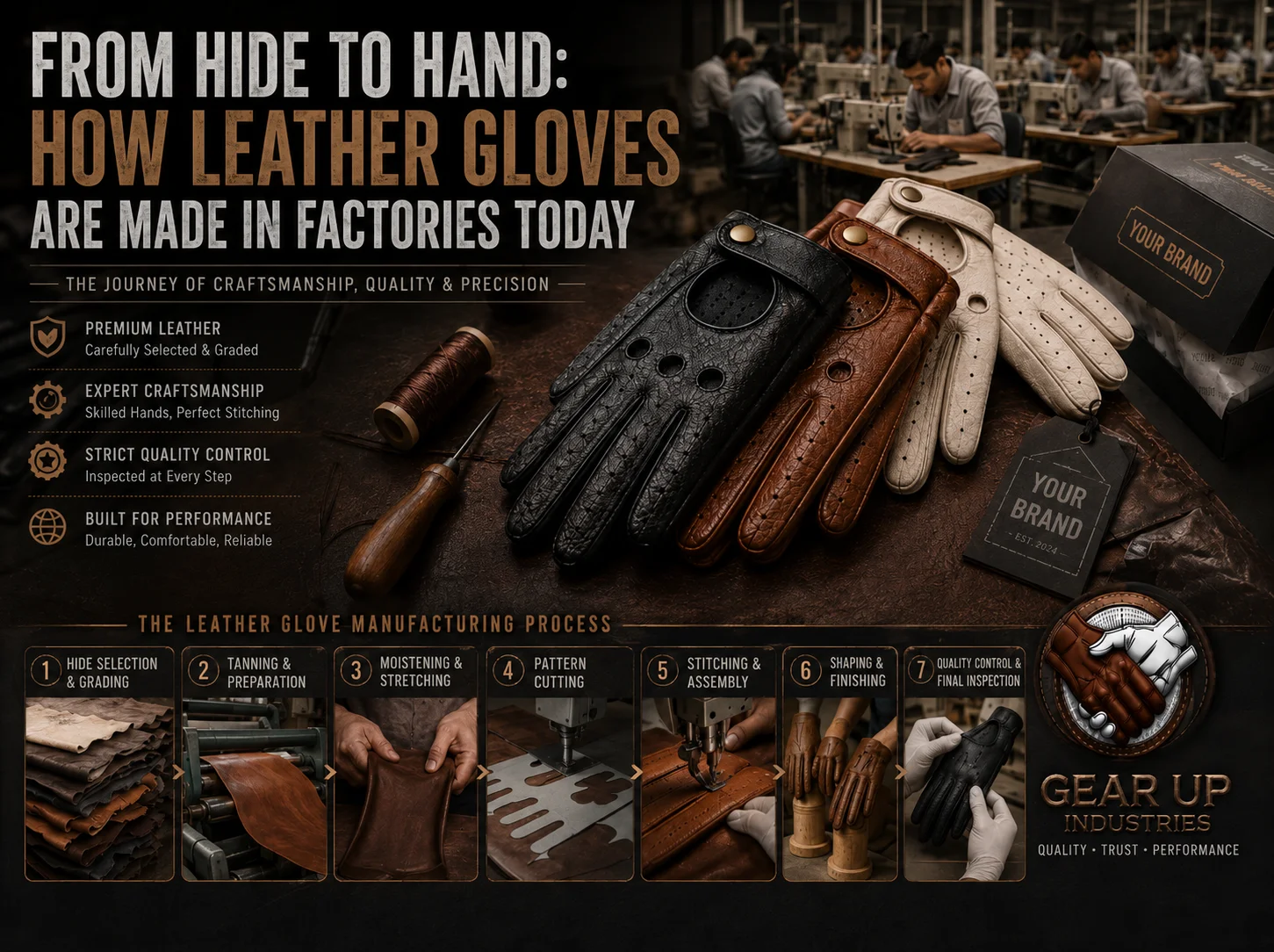
A finished pair of leather gloves looks simple enough on a shelf, but getting there involves a surprising number of hands-on stages, each one shaping how the final product fits, feels, and holds up over time. For US brands, distributors, and buyers sourcing gloves for the first time, understanding this process isn’t just an interesting background, it’s what makes a factory conversation about grading, cutting, or stitching actually make sense, rather than nodding along to terms you can’t evaluate.
This guide walks through exactly how a reliable leather glove manufacturer takes a raw hide from tannery to finished pair, and what each stage tells a buyer about the quality of the factory behind it.
Why Understanding the Manufacturing Process Matters for Buyers
Buyers who understand the manufacturing process ask sharper questions during sourcing. Instead of a vague “how do you make your gloves,” a buyer who knows the stages can ask specifically how hides are graded, how patterns are cut, or how seams are checked, which quickly separates an experienced leather glove maker from a factory reciting a generic pitch.
Step 1: Hide Selection and Grading
Every batch starts with selecting and grading raw hides, typically sheepskin, goatskin, or cowhide depending on the glove category. Hides are sorted by size, thickness, and surface quality, since even small flaws in the raw material show up clearly once the leather is cut and stitched into a fitted glove. Buyers comparing leather types before placing an order may find it useful to read our breakdown of sheepskin vs goatskin leather for custom bulk gloves, since hide choice at this stage shapes every step that follows.
Step 2: Tanning and Leather Preparation
Raw hide is tanned to convert it into a stable, flexible material that won’t stiffen, crack, or decompose over time. This stage also determines the leather’s final thickness, softness, and surface finish, all of which directly affect how the finished glove performs on the hand.
Step 3: Moistening and Stretching the Leather
Before cutting, leather is moistened to improve flexibility and stretched in multiple directions to identify which sections of the hide will become which parts of the glove. This step matters more than it sounds, since stretching the leather correctly at this stage is what allows the finished glove to move naturally with the hand instead of feeling stiff or restrictive.
Step 4: Pattern Cutting
Patterns are cut using calibrated dies shaped to the exact contours of the glove, including finger and thumb slots. Precision here is critical: a pattern cut even slightly off will throw off sizing consistency across an entire production run, which is exactly why experienced leather gloves manufacturers invest heavily in die accuracy and skilled cutters. Cutters also account for natural variation across a hide, since no single skin is perfectly uniform, positioning each pattern piece to avoid scars, stretch marks, or thin spots that would weaken the finished glove.
Step 5: Stitching and Assembly
Once cut, glove pieces move to stitching, where skilled workers or machines assemble the panels, fingers, and cuff into a complete glove.
Lining Insertion
For lined gloves, the lining is inserted using specialized hand tools and secured with fine, often invisible stitching at each fingertip, adding warmth and comfort without bulking up the fit.
Seam and Fit Checks
Manufacturers commonly test seam tension using tools inserted into the fingers to confirm stitching isn’t too tight, since overly tight seams make a glove difficult and uncomfortable to put on, even if it looks correct on a hanger.
Step 6: Shaping and Finishing
After stitching, gloves are placed on heated hand-shaped forms to remove creases from the leather and set the glove into its natural shape. This finishing stage is what gives a well-made glove its clean, structured look straight out of the box, rather than the crumpled appearance of a glove pulled straight off the sewing machine.
Materials and Hardware Beyond the Leather Itself
Leather is only part of the finished product. Linings (fleece, mesh, or thin fabric), closures (Velcro, snap buttons, or elastic), and thread all need to be sourced and matched to the glove’s intended use before production starts. A driving glove built for grip and breathability needs very different hardware and lining choices than a lined winter glove built for warmth, which is why specification decisions made before cutting even begins have such a large impact on the finished product.
Step 7: Quality Control and Final Inspection
Before packing, every pair goes through a final inspection covering stitching consistency, sizing accuracy, leather surface quality, and overall fit. A dependable leather gloves factory builds this checkpoint into every batch rather than spot-checking only a sample of the run, which is one of the clearest signs of a manufacturer worth working with long-term.
Common Defects Inspectors Look For
Experienced QC teams typically check for uneven stitching tension, mismatched leather grain or color across a pair, loose or misaligned hardware, and sizing drift between units in the same batch. Catching these issues before a shipment leaves the factory is far cheaper for everyone involved than a buyer discovering them after the gloves reach a US warehouse.
From Factory Floor to a US Warehouse: What Happens After Manufacturing
Once gloves pass final inspection, they still need to be packed, labeled, and documented for export before a shipment ever leaves the factory. This includes pairing and folding gloves to spec, applying any private label tags or retail packaging, and preparing the commercial invoice and packing list a US customs broker will need on arrival. Buyers who confirm these details with their manufacturer in advance, rather than after a shipment is already in transit, tend to avoid the last-minute paperwork delays that hold containers at port longer than necessary.
How Leather Glove Manufacturers Ensure Consistency at Scale
Consistency across a bulk order comes down to standardized dies, trained cutting and stitching teams, and documented QC checkpoints at each stage rather than only at the end. Buyers evaluating a factory for a larger order should ask specifically how consistency is maintained across hundreds or thousands of pairs, not just how a single sample was produced, since a beautiful sample tells you very little about pair number 400 in a 1,000-pair run if the factory doesn’t have real process controls in place.
Where US Brands Source Leather Gloves From Today
Domestic glove-making has deep roots in the US, particularly around Gloversville, New York, historically known as the center of American glove manufacturing, where entire communities once built their economy around cutting and stitching leather gloves by hand. Today, however, most US brands and distributors source leather gloves from specialized overseas factories that can offer lower minimum order quantities and more competitive pricing at scale, while still meeting the fit and durability standards that made the domestic industry known for quality in the first place. This is part of why so many US buyers now search specifically for a reliable leather glove manufacturer in regions with a long-established glove-making tradition, rather than relying on general leather goods factories that treat gloves as a side product with none of the specialized pattern-cutting experience that a dedicated glove factory builds up over years.
What to Look for in a Leather Glove Manufacturer
Beyond understanding the process itself, buyers should evaluate a factory’s experience with the specific glove category they need, its sampling policy, and its willingness to share references or a facility walkthrough. Our B2B sourcing guide for custom leather gloves manufacturing covers this full evaluation process in more depth, including questions worth asking before requesting a formal quote.
How Gearup Industries Manufactures Leather Gloves
Gearup Industries, based in Sialkot, Pakistan, follows this full manufacturing process for its leather golf gloves and leather driving gloves ranges, including fingerless and crochet-style designs, with quality checkpoints built in from hide grading through final inspection. You can read more about the team’s manufacturing background on the About Us page.
Frequently Asked Questions
How long does it take to manufacture a batch of leather gloves?
Standard production timelines typically run three to six weeks depending on order size, leather type, and the level of customization requested.
What’s the most important step in leather glove manufacturing?
Pattern cutting is often considered the most critical step, since even small inaccuracies here affect sizing consistency across an entire production run.
Do all leather gloves include a lining?
No. Lined gloves go through an additional stage where a lining is inserted and secured at the fingertips, while unlined gloves skip this step for a lighter, more breathable fit.
Why do some leather glove manufacturers charge more than others for a similar-looking glove?
Price differences often come down to hide grade, tanning quality, and how thoroughly a factory quality-checks each stage of production, none of which is always visible from a photo alone.
Final Thoughts
Making a leather glove properly takes far more than cutting and sewing two pieces of hide together. From hide grading and tanning through cutting, stitching, shaping, and final inspection, each stage plays a direct role in how the finished product fits and holds up over time. Buyers who understand this process are better equipped to ask the right questions and spot the difference between a genuine leather glove maker and a factory cutting corners.
Want to see this process in action for your own order? Contact Gearup Industries for samples, current MOQ, and production timelines.