

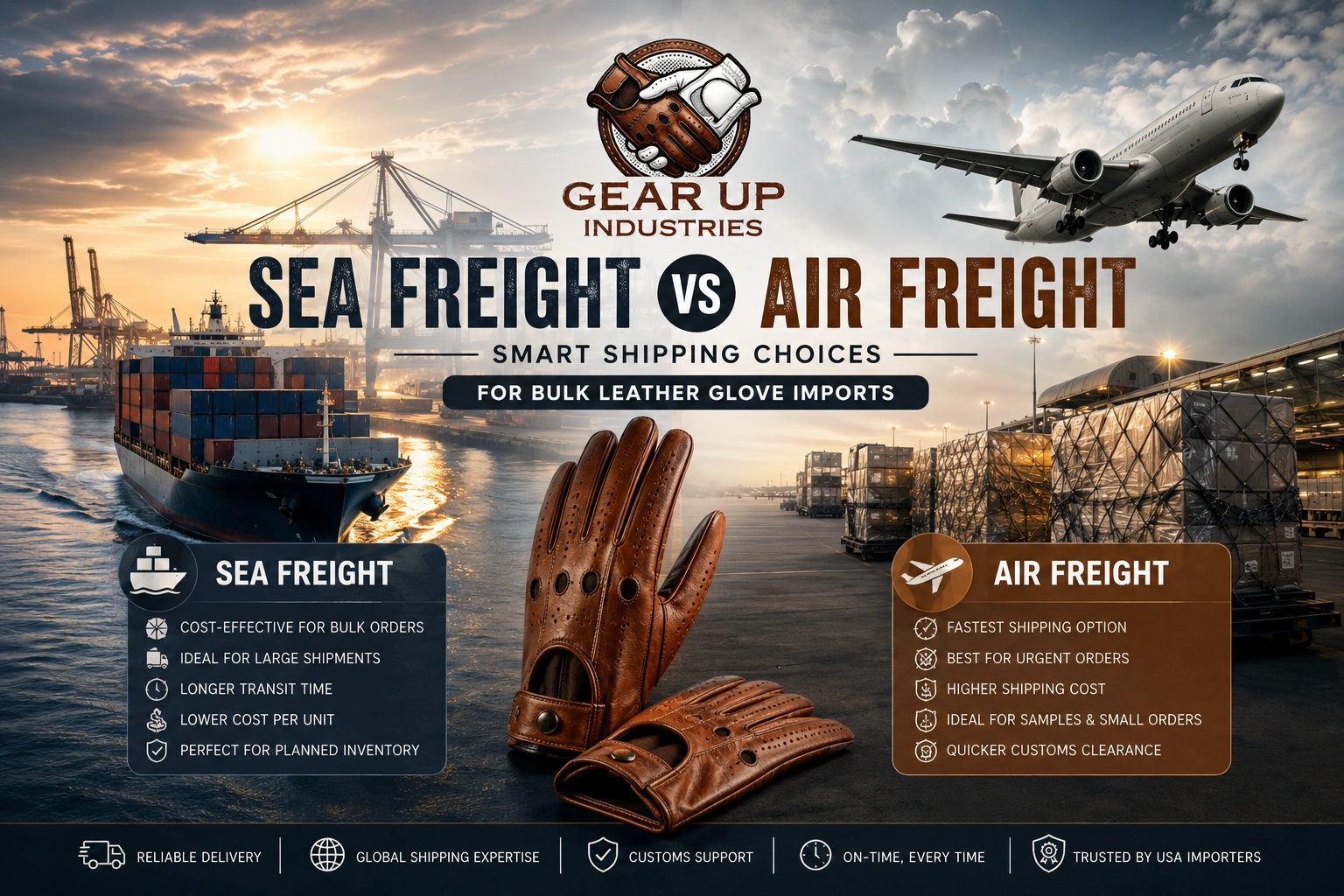
Importing leather gloves from overseas involves much more than finding the right manufacturer. Once your order moves into production, the next major decision is choosing the most suitable shipping method. For USA importers, selecting between air freight and sea freight affects not only shipping costs but also delivery timelines, inventory planning, and customer satisfaction.
Many first-time buyers focus heavily on product pricing but overlook logistics until production is complete. This often leads to unexpected freight charges, customs delays, or inventory arriving too late for seasonal demand.
Understanding how international shipping works before placing a purchase order helps businesses make better sourcing decisions and avoid costly surprises. Whether you’re importing leather driving gloves, golf gloves, or launching a private label collection, knowing when to use air freight or sea freight is an important part of successful procurement.
If you’re still evaluating manufacturers before planning logistics, our B2B Sourcing Guide for Custom Leather Gloves Manufacturing explains the complete sourcing process, from product specifications to selecting the right production partner.
Why Shipping Matters in Bulk Leather Glove Sourcing
Shipping is one of the largest expenses after manufacturing.
Even if two suppliers offer similar factory pricing, the total landed cost can vary significantly depending on freight method, shipping terms, customs handling, and destination.
Professional buyers don’t compare factory prices alone—they calculate the complete cost of getting products safely into their warehouse.
A well-planned logistics strategy helps businesses:
- Reduce overall import costs
- Improve inventory planning
- Avoid stock shortages
- Meet seasonal sales deadlines
- Maintain healthier cash flow
- Improve customer satisfaction
For growing brands, shipping decisions directly impact profitability just as much as manufacturing quality.
The Hidden Cost of Poor Shipping Planning
Many new importers believe shipping is simply arranging transportation after production finishes.
In reality, shipping should be discussed before production even begins.
Without proper planning, businesses often experience:
- Rush shipping charges
- Delayed product launches
- Unexpected customs fees
- Warehouse storage costs
- Inventory shortages
- Missed retail seasons
These problems usually cost far more than selecting the correct shipping strategy from the beginning.
Experienced manufacturers help buyers plan production schedules around expected transit times rather than waiting until goods are ready to leave the factory.
Shipping Should Be Part of Your Sourcing Strategy
Successful importers treat logistics as part of procurement—not as a separate task.
When discussing production with your manufacturer, it’s important to confirm:
- Production lead time
- Estimated shipping schedule
- Export documentation
- Preferred Incoterms
- Destination port
- Customs responsibilities
Planning these details early reduces delays and gives freight forwarders enough time to arrange transportation efficiently.
Production Timing Affects Shipping Choices
Shipping decisions often depend on production timelines.
For example:
- A new product launch may require faster delivery to meet a marketing campaign.
- Seasonal inventory for winter collections must arrive months before demand begins.
- Repeat inventory orders may use slower but more economical shipping methods.
Understanding your sales calendar helps determine whether speed or shipping cost should receive greater priority.
Communication Between Factory and Freight Forwarder Matters
One of the most overlooked parts of international sourcing is communication.
The manufacturer, freight forwarder, customs broker, and buyer must all work together using accurate documentation and realistic production schedules.
Poor communication often creates delays that have nothing to do with transportation itself.
Working with an experienced manufacturer like Gearup Industries helps simplify this process because production updates, documentation, and shipping preparation are coordinated before goods leave the factory.
Understanding the Two Main Shipping Methods
When importing leather gloves into the United States, businesses generally choose between air freight and sea freight.
Each option serves a different business purpose.
The best choice depends on:
- Order volume
- Delivery deadline
- Shipping budget
- Product value
- Inventory planning
Neither method is universally better—the right solution depends on your business goals.
What Is Air Freight?
Air freight transports cargo through commercial or dedicated cargo aircraft.
Because products travel by air instead of ocean, transit times are significantly shorter.
Air freight is commonly selected when:
- Inventory is urgently needed.
- Product launches have fixed deadlines.
- Sample orders require quick delivery.
- Small production runs are being imported.
- Stock shortages must be resolved quickly.
Although air freight offers exceptional speed, it usually carries a much higher transportation cost compared to ocean shipping.
For businesses testing new products or reviewing production samples before placing larger orders, faster delivery often justifies the additional expense.
Advantages of Air Freight
Air freight offers several business advantages:
- Faster international delivery
- Better shipment tracking
- Lower risk of long transit delays
- Faster customs processing in many cases
- Reduced warehouse planning uncertainty
For startups launching a new collection, these benefits can outweigh the higher freight charges, particularly when market timing is critical.
Limitations of Air Freight
Despite its speed, air freight is not always the most economical solution.
Businesses should also consider:
- Higher transportation costs
- Weight-based pricing
- Cargo size limitations
- Higher landed cost per unit
As production volume increases, shipping costs can quickly reduce overall profit margins.
For this reason, many experienced importers reserve air freight for urgent orders while using sea freight for routine inventory replenishment.
What Is Sea Freight?
Sea freight is the most common shipping method for bulk leather glove orders because it offers the lowest transportation cost per unit. Instead of shipping goods by air, cargo is loaded into containers and transported by ocean vessels to the destination port.
Although sea freight takes longer than air freight, it becomes far more economical as shipment volume increases. This makes it the preferred choice for wholesalers, distributors, and private label brands placing regular inventory orders.
For businesses planning seasonal inventory well in advance, sea freight provides an excellent balance between cost efficiency and shipping capacity.
Less than Container Load (LCL)
LCL (Less than Container Load) means your shipment shares container space with cargo from other importers.
This option is suitable when:
- Your order volume is relatively small.
- You’re placing your first production order.
- You don’t need an entire shipping container.
- Reducing freight costs is a priority.
Because multiple shipments share the same container, transit times can sometimes be slightly longer due to cargo consolidation and deconsolidation at ports.
Full Container Load (FCL)
FCL (Full Container Load) means your goods occupy an entire shipping container.
This option is generally recommended when:
- Importing large production volumes.
- Reordering established products.
- Shipping multiple product lines together.
- Reducing handling risks during transportation.
Since the container isn’t shared with other importers, FCL often provides better cargo security and more predictable transit schedules.
Air Freight vs Sea Freight: Which Option Is Better?
The right shipping method depends on your business priorities rather than one option being universally better.
| Factor | Air Freight | Sea Freight |
| Delivery Speed | Very Fast | Slower |
| Shipping Cost | Higher | Lower |
| Best For | Samples, urgent orders | Bulk production |
| Order Volume | Small to medium | Medium to large |
| Inventory Planning | Emergency restocking | Seasonal planning |
| Cost Per Unit | Higher | Lower |
Many experienced USA importers use both methods depending on the situation. Sample orders and urgent replenishments are often shipped by air, while standard production orders travel by sea.
Understanding Shipping Terms (Incoterms)
Before placing an order, buyers should understand which shipping responsibilities belong to the manufacturer and which belong to the importer.
Clear shipping terms reduce confusion, unexpected costs, and communication issues later in the process.
FOB (Free On Board)
Under FOB terms, the manufacturer is responsible for preparing the shipment and delivering it to the agreed departure port.
After the cargo is loaded onto the vessel, responsibility transfers to the buyer.
Many experienced importers prefer FOB because it gives them greater control over freight forwarders and shipping costs.
CIF (Cost, Insurance, and Freight)
With CIF, the manufacturer arranges ocean transportation and insurance to the destination port.
While this option offers convenience, buyers should still confirm local port charges, customs clearance fees, and inland transportation costs before comparing quotations.
EXW (Ex Works)
EXW gives buyers the greatest level of control.
The manufacturer simply prepares the completed order for collection at the factory, while the buyer arranges transportation, export procedures, freight forwarding, customs clearance, and final delivery.
This option is generally more suitable for experienced importers working with established logistics partners.
Documents Required for International Leather Glove Shipping
Accurate documentation plays an important role in avoiding customs delays.
Most international shipments require documents such as:
- Commercial Invoice
- Packing List
- Bill of Lading (Sea Freight)
- Air Waybill (Air Freight)
- Certificate of Origin (when required)
- Export Declaration
- Import Documentation requested by destination customs
Working with an experienced manufacturer helps ensure these documents are prepared correctly before the shipment leaves the factory.
Why Freight Forwarders Are Important
Freight forwarders coordinate transportation between manufacturers, shipping companies, customs brokers, and buyers.
Their responsibilities often include:
- Booking cargo space
- Managing export documentation
- Coordinating customs clearance
- Tracking shipments
- Organizing inland transportation
A reliable freight forwarder helps reduce delays while keeping buyers informed throughout the shipping process.
Common Shipping Mistakes First-Time Importers Make
Many shipping problems can be avoided with better planning.
Some of the most common mistakes include:
- Choosing air freight when delivery deadlines allow sea freight.
- Waiting until production finishes before arranging transportation.
- Comparing factory prices without calculating total landed cost.
- Failing to confirm Incoterms before placing an order.
- Ignoring customs documentation requirements.
- Not working with an experienced freight forwarder.
- Underestimating seasonal shipping congestion.
Avoiding these mistakes improves both delivery reliability and overall profitability.
Why USA Buyers Trust Gearup Industries
At Gearup Industries, we understand that successful international sourcing extends beyond manufacturing.
Our team works closely with wholesalers, distributors, OEM buyers, and private label brands by helping them coordinate production schedules with efficient export planning.
From sample shipments to large production orders, we assist customers throughout the sourcing process by providing:
- Production updates
- Export-ready documentation
- Flexible manufacturing
- OEM and private label support
- Quality inspections before shipment
- Reliable communication throughout production
Whether you’re importing Leather Golf Gloves or Leather Driving Gloves, our goal is to help your products arrive on schedule with the documentation and preparation needed for a smooth importing experience.
For buyers comparing manufacturing partners, our guide on How to Choose the Right OEM & Private Label Leather Gloves Factory provides additional insights into selecting a dependable supplier.
Frequently Asked Questions
Is sea freight cheaper than air freight?
Yes. Sea freight usually offers a much lower transportation cost per unit, making it the preferred option for bulk leather glove orders.
When should I choose air freight?
Air freight is best for urgent shipments, production samples, product launches, or situations where inventory is needed quickly.
What shipping method do most USA importers use?
Most established importers use sea freight for regular inventory while reserving air freight for emergency replenishment or sample shipments.
What is FOB shipping?
FOB means the manufacturer delivers the goods to the departure port and loads them onto the vessel. After loading, responsibility transfers to the buyer.
Can Gearup Industries help with export shipping?
Yes. Gearup Industries supports international buyers by preparing export documentation, coordinating production schedules, and assisting with logistics planning to help shipments move efficiently.
Final Thoughts
Choosing the right shipping method is just as important as selecting the right manufacturer. While air freight provides unmatched speed for urgent orders and product samples, sea freight remains the most cost-effective solution for bulk leather glove sourcing. Understanding Incoterms, preparing the correct documentation, and working with experienced logistics partners helps businesses reduce unexpected costs and keep inventory moving smoothly.
For USA brands, wholesalers, and private label companies, planning shipping early in the sourcing process leads to better cash flow, fewer delays, and more reliable product launches.
At Gearup Industries, we help international buyers not only manufacture premium leather gloves but also prepare them for efficient global shipping. From production to export documentation, our team is committed to making the sourcing process as straightforward and dependable as possible.