

When a U.S. brand develops a leather glove collection, the stitching specification is easy to overlook. Most buyers naturally focus first on leather, color, lining, sizing, and branding. But the way leather panels are joined can affect the glove’s appearance, flexibility, seam feel, and manufacturing consistency.
For a private-label or wholesale glove buyer, understanding leather glove stitching types makes product development easier. It helps you communicate your requirements to a manufacturer, compare samples accurately, and identify construction issues before a bulk order reaches production.
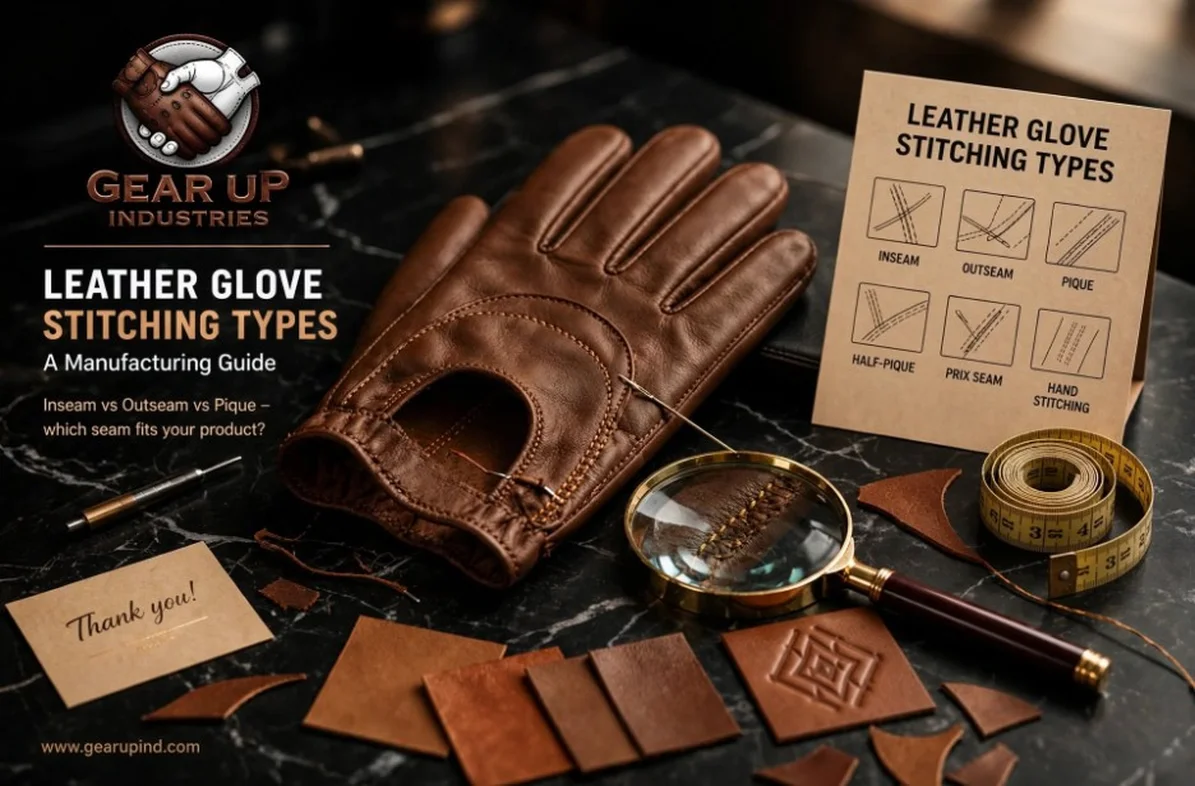
Common leather glove constructions include inseam, outseam, pique, half-pique, prix seam, and hand stitching. They are not interchangeable. Each creates a different relationship between the leather edges, thread, and finished seam.
For U.S. brands sourcing leather gloves internationally, the important question is not simply, “Which stitch is best?” The better question is:
Which seam construction fits the glove’s intended use, design, leather, target price, and production requirements?
What Is Leather Glove Stitching?
Leather glove stitching is the process used to join the individual leather components that form the fingers, thumb, palm, back, and other parts of a glove.
Unlike fabric, leather does not behave exactly like a textile when pierced by a needle. Stitch placement, edge alignment, thread tension, and seam allowance all contribute to the finished construction.
Traditional glove-manufacturing references identify several specialized seam constructions, including prix seam, gauge seam, full pique, inseam, overseam, saddle stitch, triplestitch, tystitch, and whipstitch.
Why Stitching Matters to a Glove Brand
A stitching method can influence:
- The visible appearance of the glove
- How much seam bulk is felt
- Finger flexibility
- Overall fit
- Seam durability
- Manufacturing complexity
- Production cost
- The visual character of the finished product
For a U.S. brand ordering several hundred or more pairs, these details become important because a construction decision made during sampling will be reproduced across the production run.
Stitch Type vs. Seam Construction
The terms stitch type and seam construction are often used together, but they describe slightly different things.
The stitch refers to how the thread passes through the leather.
The seam describes how two or more leather components are positioned and joined.
For example, an inseam describes the location and arrangement of the joined leather edges, while the stitching describes how those edges are secured.
Understanding this difference can make communication with an overseas glove factory much clearer.
Main Leather Glove Stitching Types
Not every construction is appropriate for every glove. A manufacturer normally considers the leather, pattern, intended application, appearance, and production requirements before selecting a seam.
Inseam Stitching
With an inseam, the seam is constructed toward the inside of the glove. The exterior therefore has a cleaner appearance because the seam allowance is not prominently exposed.
This construction can be useful for glove styles where the brand wants the leather surface and overall silhouette to remain visually clean.
Why Brands Consider Inseams
An inseam may be considered when a product specification prioritizes:
- A clean exterior
- Minimal visible seam detail
- A refined appearance
- Controlled seam placement
The trade-off is that producing an accurate inseam can require greater care, particularly around narrow finger sections.
What to Check on an Inseam Sample
When evaluating a sample, don’t inspect only the outside.
Turn the glove inside out and check the finger seams, thumb attachment, and areas where several components meet.
Buyer QC Point
The seam should be secure and consistently positioned without excessive bunching, loose thread, or distortion of the leather.
Outseam Stitching
An outseam places the joined leather edges on the outside of the glove, making the seam visible.
Instead of trying to hide the construction, the seam becomes part of the glove’s appearance.
This can work well for designs where visible stitching contributes to the intended style. It can also be useful when the manufacturer wants to avoid having a prominent internal seam in a particular contact area.
Outseams for Driving Glove Designs
Driving gloves are one area where seam placement deserves particular attention.
The wearer repeatedly grips and releases the steering wheel, so the pattern, leather flexibility, and seam position should work together.
Traditional glove-manufacturing references describe prix seam as an outseam construction and associate it with heavier glove categories, including driving gloves.
This makes seam construction a useful specification for a U.S. automotive lifestyle brand developing a private-label driving glove rather than something that should be left entirely to the factory.
Pique Stitching
Pique, also called a lap seam, involves one leather edge overlapping another.
The stitching is positioned very close to the edge. Because of this, the construction demands accurate cutting and sewing.
Technical glove references describe full pique as a comparatively difficult seam because the stitching must be made right at the leather edge, particularly around finger closures.
Full Pique vs. Half Pique
Full pique and half pique are related constructions but are not identical.
Full pique uses the lapped construction more extensively, while half pique combines pique construction with another seam approach.
The choice can affect both appearance and manufacturing time.
A current example of commercial leather glove construction is the use of half-piqué seams along the fingers in a deerskin glove, showing how the construction can be incorporated as a visible design feature.
Prix Seam
A prix seam is an exposed seam construction in which the leather edges are joined and the stitching remains visible.
The U.S. National Bureau of Standards’ historical leather-glove guidance describes prix seam as an outseam produced on a flat machine, with the raw edges visible.
For a buyer, this means the seam should not be evaluated only for strength. Its visual consistency is also part of the finished product.
Where Prix Seam Can Fit
Prix construction can be considered for designs where visible external seams are intentional, particularly certain driving and heavier glove styles.
The final choice should still be based on the actual glove pattern and leather rather than assuming that one seam is automatically suitable for every driving glove.
Hand Stitching vs. Machine Stitching
Another decision for private-label development is whether the product should use hand stitching, machine stitching, or a combination of both.
Hand Stitching
Hand stitching involves considerably more manual work and can be appropriate for specialized designs where craftsmanship and detailed finishing are important.
Historical glove-making sources describe hand sewing as a skilled construction process. Modern production, however, often requires more repeatable machine-based methods for commercial quantities.
For a U.S. brand, the practical question is whether the additional labor supports the intended product positioning and production volume.
Machine Stitching
Machine stitching is generally more suitable when a manufacturer needs to reproduce a construction consistently across a commercial order.
A machine setup can help standardize:
- Stitch spacing
- Seam position
- Thread appearance
- Production speed
- Repeatability between pairs
However, machine stitching does not remove the need for skilled operators and quality inspection.
Leather glove production still involves specialized stitching work; even industrial occupation classifications separately recognize leather-glove-stitching machine operators and glove stitchers.
How Stitching Type Affects Different Leather Gloves
The right seam construction depends heavily on what the glove is supposed to do.
Leather Driving Gloves
Driving gloves require a combination of hand movement, tactile contact, and visual appeal.
A U.S. automotive accessories brand may therefore prioritize a seam that supports the intended finger movement while also fitting the product’s styling.
For example, an exposed seam can become a recognizable design feature, while a more concealed construction may support a cleaner appearance.
Brands developing a driving glove collection can compare construction choices alongside their product style, such as full-finger, fingerless, or crochet-back leather driving gloves.
Leather Golf Gloves
Golf gloves have different construction priorities.
Fit, flexibility, tactile feel, and secure contact with the club all matter. A seam that looks attractive but interferes with the intended fit is not necessarily the right choice.
For buyers developing a private-label golf glove range, stitching should therefore be evaluated alongside leather selection, sizing, closure, and grip-related construction.
A brand can use the broader leather golf gloves category as the starting point for defining the product before finalizing the stitching specification.
Fashion and Lifestyle Leather Gloves
Fashion-oriented gloves place greater emphasis on visual finishing.
For these products, seam visibility can be deliberate. Pique stitching, for example, can become part of the design rather than something the manufacturer attempts to conceal.
The appropriate construction depends on the brand’s intended aesthetic, leather choice, and target retail position.
How a Manufacturer Selects the Right Seam Construction
A professional glove manufacturer should evaluate the stitching method together with the rest of the pattern.
Leather Type and Thickness
Leather characteristics influence how easily a particular seam can be produced.
A soft, lightweight leather behaves differently from a thicker or firmer hide. The manufacturer must consider how the material folds, stretches, and responds to needle penetration.
This is also why buyers should avoid specifying the seam without specifying the leather.
If you’re still deciding between materials for a bulk order, the differences between sheepskin and goatskin leather for custom gloves are worth considering before locking the final construction.
Glove Pattern
The pattern determines where leather components meet.
Finger sections are particularly sensitive because they are narrow and curved. Small inconsistencies can become obvious once the glove is turned, worn, or stretched.
The thumb area also deserves attention because it connects separate sections while allowing substantial hand movement.
Intended Use
The intended application should guide the construction.
A manufacturer may approach the stitching differently for:
- Driving gloves
- Golf gloves
- Fashion gloves
- Outdoor gloves
- Work-oriented leather gloves
There is no universal “best” seam independent of the product.
Production Volume
Production quantity also matters.
A construction that works well for a highly specialized small run may require a different production approach when a U.S. brand needs a repeatable bulk order.
This is one reason sample approval should happen before production begins.
Leather Glove Stitching Quality Control Checklist
Stitching should be included in the buyer’s quality-control checklist rather than treated as a minor finishing detail.
Check Seam Alignment
The seam should follow the approved pattern consistently.
Look for:
- Uneven seam placement
- Wavy stitching
- Inconsistent edge distance
- Misaligned leather panels
- Excessive seam allowance
Check Stitch Consistency
Inspect the spacing and appearance of the stitches.
The goal is not simply to have “strong stitching.” The production pair should match the approved sample in appearance and construction.
Check Thread Tension
Thread should be secure without visibly pulling the leather together or leaving loose loops.
Excessive tension can distort soft leather, while insufficient tension can compromise the appearance and security of the seam.
Inspect the Thumb and Finger Areas
These are particularly important inspection points.
Check:
- Finger seams
- Fingertips
- Thumb attachment
- Thumb crotch
- Palm-to-finger transitions
- Cuff connection
Compare Bulk Production With the Approved Sample
For a private-label order, the approved sample should act as the reference.
If the bulk production has noticeably different seam placement, stitch density, thread appearance, or fit, the difference should be investigated before shipment.
Don’t Inspect Only One Pair
A single perfect sample does not prove production consistency.
Buyers should inspect an appropriate selection of production pairs according to their agreed quality-control process.
Focus on Repeatability
The real manufacturing question is:
Can the factory reproduce the approved construction consistently across the entire order?
That is more useful to a B2B buyer than judging one isolated pair.
How to Specify Stitching When Ordering Private-Label Leather Gloves
A common mistake among new brands is sending a product image to a manufacturer and asking for a quotation without describing the construction.
A better approach is to build a technical product specification.
Include These Stitching Details
Your specification can include:
- Seam construction
- Stitch appearance
- Thread color
- Stitch density where required
- Seam placement
- Reinforcement requirements
- Leather type
- Leather thickness where applicable
- Glove pattern
- Size range
- Lining
- Branding and packaging
The more important the construction is to your product identity, the more clearly it should be documented.
Use Sampling Before Bulk Production
Sampling allows a brand to test the actual construction rather than relying on photographs or descriptions.
For a U.S. private-label buyer working with an overseas manufacturer, this step is especially useful because it provides a physical reference before committing the complete production quantity.
Gearup Industries B2B sourcing approach includes custom sampling and prototyping as part of product development, making the sample stage a natural point to review stitching, fit, leather, and finishing together.
Stitching and Other Manufacturing Decisions Should Work Together
Stitching should never be treated as an isolated specification.
The final glove is a combination of:
- Leather
- Pattern
- Seam construction
- Thread
- Lining
- Sizing
- Grip or reinforcement details
- Branding
- Finishing
- Packaging
For example, a U.S. brand may select a particular leather because of its softness, then discover during sampling that the original seam specification does not provide the desired fit. Adjusting the construction at the sample stage is much easier than discovering the problem after bulk production.
This is also why a structured B2B sourcing process for custom leather gloves can help brands organize material, construction, sampling, QC, and production decisions before placing an order.
Choosing a Leather Glove Manufacturer for Your Stitching Requirements
When comparing manufacturers, do not evaluate suppliers only by their quoted unit price.
Ask how they handle the construction itself.
Questions to Ask Before Production
A U.S. buyer can ask:
- Which seam construction do you recommend for this pattern?
- Can you reproduce the requested stitching consistently?
- Is the construction suitable for the selected leather?
- Can you provide a pre-production sample?
- Can the thread color be customized?
- How is stitching checked during production?
- Can the same construction be reproduced across different sizes?
- Can you accommodate private-label branding and packaging?
These questions help reveal whether the supplier understands your product or is simply quoting against a reference photograph.
Why the Factory’s Construction Experience Matters
Leather glove production requires specialized cutting, sewing, and fit control. A supplier experienced with leather gloves is better positioned to discuss how a seam interacts with the pattern and leather than a general apparel manufacturer.
For brands comparing suppliers, the OEM and private-label leather glove factory selection process should therefore include construction capability, sampling, communication, and quality control, not just MOQ and price.
Frequently Asked Questions
What are the main types of leather glove stitching?
Common leather glove seam constructions include inseam, outseam, pique, half-pique, prix seam, and various hand- or machine-sewn constructions.
Which stitching type is best for leather driving gloves?
There is no single best construction for every driving glove. Seam selection should consider the glove pattern, leather, intended appearance, flexibility, and manufacturing requirements. Prix seam is historically associated with certain driving and heavier glove constructions.
What is an inseam on a leather glove?
An inseam places the seam toward the inside of the glove, producing a cleaner exterior appearance.
What is a pique seam?
Pique is a lapped seam in which one leather edge overlaps another. The stitching is positioned close to the edge, requiring accurate sewing.
What is the difference between pique and half-pique?
Full pique uses the lapped construction more extensively, while half-pique combines pique construction with another seam approach. The exact configuration depends on the glove pattern.
Should private-label brands specify the stitching type?
Yes. If seam appearance, position, or construction is important to the product, it should be included in the technical specification and confirmed through sampling.
How can I check stitching quality on bulk leather gloves?
Inspect seam alignment, stitch consistency, thread tension, leather-edge alignment, finger seams, thumb attachment, and consistency against the approved sample.
Can stitching be customized for a private-label glove?
Stitch construction, thread appearance, and other manufacturing details can be discussed during product development, depending on the glove pattern, leather, and manufacturer’s capabilities.
Final Takeaway
Leather glove stitching is a small-looking manufacturing detail with a large effect on the finished product.
For a U.S. brand sourcing leather gloves, understanding inseams, outseams, pique, half-pique, prix seams, and machine versus hand stitching makes it easier to communicate with a manufacturer and evaluate samples objectively.
The right construction depends on the leather, pattern, intended use, appearance, production volume, and quality requirements. Instead of asking a factory for “strong stitching,” define the construction you want, test it through sampling, and make the approved sample the reference for bulk production.
That approach gives a private-label buyer a much clearer path from product concept to consistent finished gloves.