
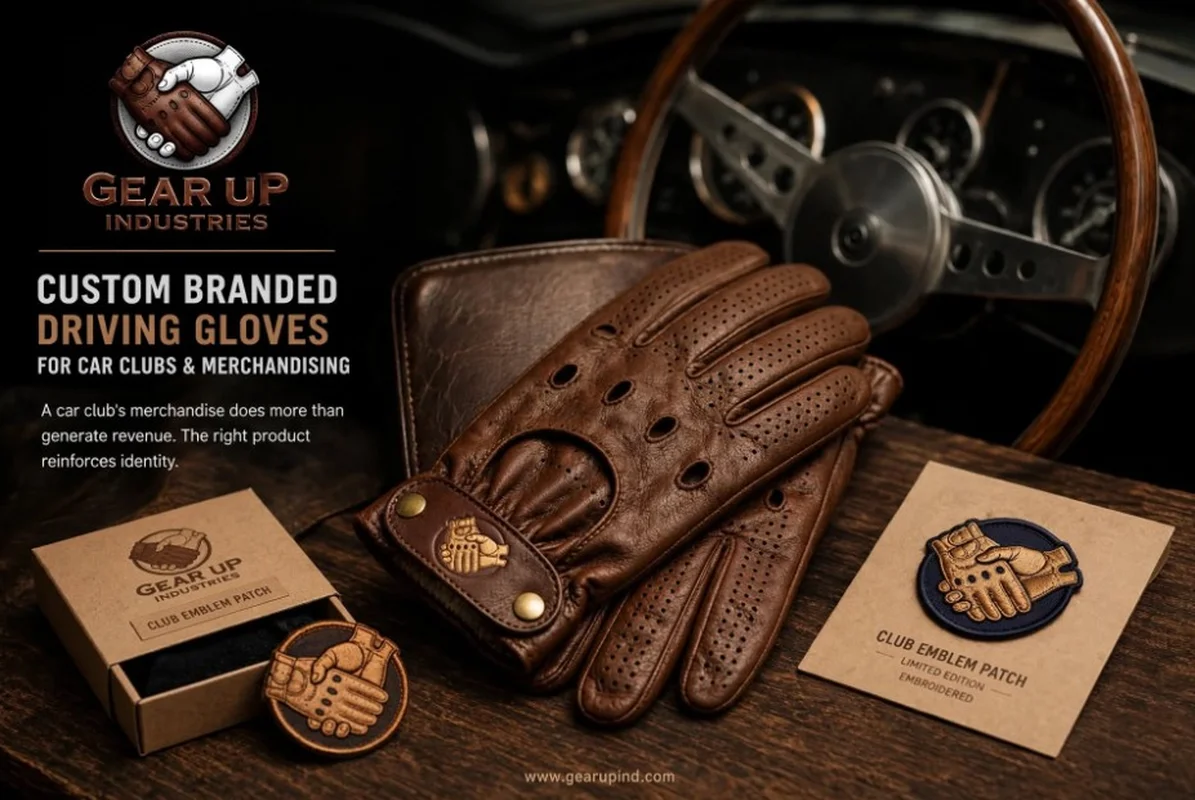
A car club’s merchandise does more than generate revenue. The right product reinforces the identity of the club, gives members something worth keeping, and can turn an automotive community into a recognizable lifestyle brand.
That makes custom branded driving gloves an interesting merchandise option for car clubs, collector communities, automotive retailers, racing organizations, dealerships, and private-label automotive brands.
Unlike a standard promotional item, a leather driving glove is closely connected to the culture of driving. It can carry a club emblem, event identity, or automotive brand without looking like conventional promotional merchandise.
But developing a successful glove program requires more than adding a logo to an existing product. Buyers need to make decisions about glove construction, leather, color, branding, sizing, packaging, sampling, order quantity, and the markets where the product will be sold.
For organizations sourcing internationally, the manufacturing partner also needs to understand the difference between a one-time merchandise order and a repeatable private-label product line.
This guide explains how B2B buyers can approach the process from product concept to bulk production.
Why Custom Driving Gloves Work for Car Club Merchandise
Car clubs already have a strong connection with driving culture, making driving gloves a natural extension of their merchandise range.
A branded glove can work particularly well for:
- Classic car clubs
- Sports car clubs
- Collector-car communities
- Motorsport organizations
- Automotive lifestyle brands
- Dealership merchandise programs
- Driving schools and events
- Rally and touring groups
- Automotive retailers
- Private-label accessory brands
The product needs to feel relevant to the club
The strongest merchandise does not simply display a logo. It makes sense for the audience buying it.
A vintage-car club, for example, may prefer a traditional leather glove with a heritage appearance. A modern performance-car community may want a cleaner, more contemporary design.
This is why product selection should come before branding execution.
Driving gloves can support several merchandise models
A club can use the same basic product for different commercial purposes:
| Merchandise model | Typical purpose |
| Member merchandise | Products offered to existing club members |
| Event merchandise | Gloves sold or distributed at rallies and automotive events |
| Limited editions | Anniversary or special-event releases |
| Online merchandise | Products sold through the club’s website |
| Retail merchandise | Products supplied to automotive stores or dealers |
| Private label | A permanent branded glove collection |
The commercial model determines how much customization makes sense.
A one-time event may require straightforward logo branding, while a long-term merchandise program may justify custom colors, packaging, labels, and a more developed product specification.
Choosing the Right Leather Driving Glove Style
The glove style is one of the first decisions a buyer should make.
Gearup Industries‘ driving-glove range includes different constructions that can suit different automotive identities and merchandise concepts.
Full-Finger Leather Driving Gloves
Full-finger driving gloves provide a classic appearance and offer a large surface area for developing a refined branded product.
They can be suitable for:
- Premium automotive brands
- Classic-car clubs
- Luxury driving communities
- Collector groups
- Automotive retailers
- Heritage-focused merchandise
For buyers developing a permanent merchandise line, full-finger gloves can provide a strong foundation because the design can be adapted through leather, color, stitching, branding, and packaging.
When should a club choose a full-finger design?
Consider this style when the product needs to communicate a traditional, premium, or heritage-oriented automotive identity.
A full-finger design may also make sense when the merchandise is intended for retail rather than only for event distribution.
Leather finish matters as much as the logo
A club logo cannot make an unsuitable glove feel premium.
The leather’s surface appearance, flexibility, consistency, and finish should support the intended positioning of the merchandise.
Match the leather character to the brand
A vintage automotive brand may benefit from a classic leather appearance, while a contemporary automotive business may prefer a cleaner, more uniform finish.
The leather should therefore be selected as part of the brand specification rather than treated as a secondary manufacturing detail.
Fingerless Leather Driving Gloves
Fingerless driving gloves can create a stronger vintage and enthusiast-oriented appearance.
They are particularly relevant to merchandise programs built around:
- Classic automobiles
- Heritage driving
- Collector communities
- Vintage rallies
- Automotive lifestyle brands
For buyers interested in this style, Gearup Industries’ fingerless leather driving gloves can provide a relevant product category to evaluate during the development stage.
Why fingerless construction can work for merchandise
The distinctive appearance immediately communicates a driving-oriented aesthetic.
That can make fingerless gloves especially useful when the merchandise itself needs to become part of the club’s visual identity.
Evaluate construction before approving branding
The logo should not be considered independently from the glove pattern.
The buyer should first confirm how the hand, finger openings, cuff, seams, and available branding area work together.
Sample the actual construction
A digital logo mock-up cannot show how branding will look on the finished leather surface.
A physical sample is therefore valuable before approving a production order.
Crochet-Back Leather Driving Gloves
Crochet-back driving gloves offer another design direction, particularly for warmer-season events and heritage-oriented automotive merchandise.
The combination of a leather palm with a crochet-style back can create a visually distinctive product.
For clubs considering this construction, crochet leather driving gloves are worth evaluating as a separate product direction rather than treating the style as simply another color variation.
How to Customize Driving Gloves for a Car Club
Once the glove construction is selected, the next step is developing the branding specification.
Logo placement
Logo placement should be decided according to both visibility and product aesthetics.
Potential areas may include:
- Backhand
- Cuff
- Label
- Packaging
- Hangtag
- Other suitable product surfaces
The best placement depends on the glove construction and the branding method.
A premium automotive brand may prefer a small, understated logo, while an event merchandise program may require more visible club identification.
Logo embossing and other branding methods
Leather provides several potential branding approaches, depending on the selected material and design.
The buyer should discuss options such as:
- Embossed branding
- Debossed branding
- Printed branding
- Woven labels
- Custom labels
- Branded packaging
The important consideration is consistency.
A logo that looks excellent on a digital presentation can appear different when transferred to leather, so the final method should be assessed during sampling.
Custom colors
Color can make a standard glove feel like a proprietary product.
For example, a club could incorporate:
- Its primary brand color
- Accent stitching
- Contrasting leather panels
- Event-specific colors
- Limited-edition colorways
However, customization should remain controlled.
Too many colors, logos, and design elements can make a premium driving glove look more like promotional merchandise than a professionally developed automotive accessory.
Custom Packaging for Automotive Merchandise
Packaging becomes increasingly important when the glove is sold rather than simply distributed.
Why packaging matters
A customer receiving a glove in branded packaging experiences the product as a complete merchandise item.
Packaging can include:
- Club branding
- Product name
- Size information
- Care information
- Brand story
- Product inserts
- Barcodes or SKU information where required
Build packaging around the sales channel
A glove sold at a weekend car show may need a simpler presentation than one sold through an automotive retailer.
Likewise, a private-label brand selling online may need packaging designed for shipping and retail presentation.
Do not finalize packaging too early
Packaging dimensions can depend on the final glove construction, folding method, labels, and accessories.
For this reason, the physical product specification should be confirmed before final packaging artwork is approved.
Car Club Merchandise vs. Private-Label Driving Gloves
These two approaches are related, but they are not identical.
Bulk branded merchandise
Bulk merchandise is appropriate when a club wants a proven glove style in quantity with its branding applied.
A typical project might involve:
- Selecting an existing glove style
- Choosing leather and color
- Supplying the club logo
- Confirming sizes
- Approving a sample
- Ordering the finished quantity
This approach can work well for annual events, member merchandise, or a first product launch.
Private-label driving gloves
Private label is a deeper product-development approach.
The buyer may define:
- Product construction
- Leather selection
- Color
- Stitching
- Logo treatment
- Size range
- Labels
- Packaging
- Product specifications
This makes more sense when the glove is intended to become a recurring part of a brand’s merchandise portfolio.
For organizations exploring broader B2B manufacturing requirements, Gearup Industries’ B2B sourcing guide for custom leather gloves manufacturing can provide additional context on the sourcing process.
Sizing Is a Critical Part of Club Merchandise
Sizing is easy to underestimate when the buyer is purchasing gloves for a large membership base.
Unlike one-size promotional products, gloves need to fit different hand dimensions.
Build a practical size range
Before placing a bulk order, determine:
- Which sizes your members are likely to need
- Whether men and women will require different size distributions
- Whether the club wants a broad size range
- How replacement or repeat orders will be handled
Men’s and women’s sizing should not be assumed to be identical
A club serving a mixed membership should not automatically use a single size distribution based on the assumption that every customer will fit the same pattern.
The manufacturer should confirm the available sizing structure during development.
Use actual demand when planning quantities
For an established club, previous merchandise sales can help estimate the size breakdown.
For a new merchandise program, a preliminary member survey can provide useful information before production.
Avoid ordering equal quantities of every size by default
An equal size split may look simple on paper but may not reflect the actual customer base.
A more practical distribution should be based on expected demand and adjusted after the first sales cycle.
MOQ and Quantity Planning for Car Clubs
Quantity is one of the biggest differences between a club merchandise project and a conventional consumer brand.
A club may know how many members it has but still not know how many people will purchase the product.
Gearup Industries’ MOQ starts from 100 pairs per design, providing a defined starting point for organizations that want to test a branded glove concept without immediately developing a very large collection.
How to estimate your initial quantity
Consider four numbers:
- Expected first-order customers
- Event or launch demand
- Size distribution
- Replacement and future-sales requirements
A simple example might look like:
| Program | Main quantity consideration |
| 100-member club | Member interest and size distribution |
| Automotive event | Expected sales during the event |
| Online launch | Initial demand plus safety stock |
| Limited edition | Planned release quantity |
| Retail program | Store demand and replenishment |
| Annual club collection | Previous sales and reorder history |
The objective is not simply to order the largest possible quantity. It is to create enough inventory to test demand while avoiding unnecessary stock exposure.
Sampling Before Bulk Production
Sampling should be treated as part of product development rather than a formality.
A sample gives the buyer an opportunity to evaluate the physical product before committing to bulk production.
What should be checked?
Review the sample for:
- Leather appearance
- Leather consistency
- Stitching
- Seam alignment
- Glove dimensions
- Fit
- Finger length
- Cuff construction
- Logo placement
- Branding quality
- Color
- Packaging
Check the branding and the glove separately
A sample can have an excellent logo application but still have problems with sizing or construction.
Likewise, a well-made glove may require adjustments to logo scale or placement.
The approval process should therefore evaluate the entire product.
Create an approved product specification
Once the sample is accepted, document the approved details.
This can include:
- Leather specification
- Color
- Size range
- Logo dimensions
- Logo position
- Stitching requirements
- Packaging
- Labels
Use the approved sample as the production reference
A clearly approved reference reduces ambiguity when the product moves from sampling to bulk manufacturing and helps establish a common reference for future repeat orders.
Quality Control for Custom-Branded Gloves
The presence of a club logo makes quality control more important, not less.
Every pair represents the organization.
Product-level quality checks
B2B buyers should consider reviewing:
- Leather appearance
- Stitch consistency
- Seam construction
- Size consistency
- Logo accuracy
- Color consistency
- Cuff finishing
- Packaging presentation
Branding-level quality checks
The branding should also be checked for:
- Correct logo
- Correct orientation
- Correct position
- Consistent scale
- Clean application
- Consistent appearance
A strong QC process protects both the product investment and the reputation of the club or automotive brand.
Selling Custom Driving Gloves in International Markets
Car-club merchandise is not limited to one geographic market.
Automotive communities in the United States, United Kingdom, Canada, Germany, wider Europe, Australia, New Zealand, and the UAE can all have different purchasing patterns, seasonal considerations, and merchandise expectations.
Do not design one product around every market automatically
International demand does not mean every market requires the same glove specification.
A core product can remain consistent while packaging, promotional positioning, seasonal quantities, or selected colorways are adapted to the target market.
Building a Repeatable Car Club Merchandise Program
The most valuable custom glove projects are not necessarily one-time orders.
A club can use its first production run to establish a repeatable merchandise system.
Start with one core design
Instead of launching several glove designs simultaneously, consider starting with one strong product.
Establish:
- Core glove construction
- Leather
- Brand colors
- Logo placement
- Size range
- Packaging
Then use customer feedback to decide whether additional variations are justified.
Expand through limited editions
Once the core product is established, additional versions can be introduced for:
- Club anniversaries
- Major automotive events
- Rally seasons
- New vehicle launches
- Sponsor partnerships
- Collector releases
This approach allows a club to create variety without rebuilding its entire merchandise strategy every time.
Reorders become easier when specifications are documented
A repeat order should not require starting the product-development process from zero.
A documented specification can make future purchasing more straightforward by providing a reference for the product, branding, sizing, and packaging.
How to Choose a Driving Glove Manufacturer
The manufacturer should be evaluated on more than price.
Product specialization
Look for a supplier that understands leather glove construction rather than treating gloves as a generic promotional product.
Customization capability
Ask whether the manufacturer can support the specific requirements you need, such as:
- Logo application
- Color selection
- Size customization
- Packaging
- Labels
- Sampling
- Private-label production
Communication during sampling
The sampling stage is where many important product decisions are resolved.
A manufacturer should be able to discuss practical issues rather than simply accept artwork and return a finished sample without product-development input.
Export experience
For buyers in the US, UK, Canada, Germany, Europe, UAE, Australia, and New Zealand, international sourcing also requires attention to documentation, packaging, shipping arrangements, and destination-market requirements.
Gearup Industries is based in Sialkot, Pakistan, a major manufacturing center for leather and sports goods, and focuses on leather glove production for international B2B buyers.
What to Include in a Custom Glove Manufacturing Brief
A manufacturer can evaluate a project more efficiently when the initial inquiry contains enough information.
Your brief should include:
- Glove style — full-finger, fingerless, or crochet-back
- Leather preference — if known
- Color — standard or custom
- Estimated quantity
- Logo artwork
- Preferred logo position
- Required size range
- Packaging requirements
- Target market
- Sampling requirement
- Reference images or existing samples
- Expected merchandise use
If you are developing a product from an existing glove, provide photographs or a physical reference where possible.
If the concept is new, a sketch or specification sheet can help communicate the intended direction.
From Club Logo to Finished Merchandise
A successful custom-branded driving glove program begins with the understanding that the glove is a product—not simply a surface for printing a logo.
The best results come from making the major decisions in the right order:
- Define the merchandise objective.
- Choose the appropriate glove construction.
- Select the leather and color direction.
- Establish the branding treatment.
- Build the size range.
- Develop packaging if required.
- Produce and evaluate a sample.
- Approve the complete specification.
- Move into bulk production.
- Use the documented specification for future reorders.
For a smaller car club, the project may begin with 100 pairs of one design. For a larger automotive brand, the same process can develop into a permanent private-label accessory collection.
The important distinction is that both projects should be approached with the same manufacturing discipline.
Gearup Industries can support B2B buyers looking to develop leather driving gloves for branded merchandise, wholesale supply, or private-label programs.
For organizations ready to move from a merchandise idea to a defined product specification, the next step is to prepare the glove style, logo, estimated quantity, size requirements, and packaging expectations for a custom manufacturing discussion.
Frequently Asked Questions
What is the MOQ for custom branded driving gloves?
Gearup Industries’ MOQ starts from 100 pairs per design. The final order structure depends on the selected glove style, specifications, and customization requirements.
Can car clubs put their own logo on leather driving gloves?
Yes. A car club can develop a branded glove using an appropriate logo application method. The exact placement and branding technique should be confirmed during product development and sampling.
Can we customize the leather color for our car club?
Custom color requirements can be discussed as part of the product specification. Buyers should provide their preferred color direction and confirm the available options with the manufacturer before approving a sample.
Should we order a sample before placing a bulk order?
Yes. Sampling allows the buyer to evaluate the leather, construction, sizing, branding, color, and overall appearance before moving into bulk production.
Can custom driving gloves be sold through a club’s online store?
Yes. Custom gloves can be developed for online club stores, automotive events, membership programs, retail resale, or other merchandise channels.
What is the difference between custom merchandise and private-label driving gloves?
Custom merchandise generally involves selecting a glove and adding the club’s branding. Private-label manufacturing goes further by developing the product around the buyer’s own specifications, potentially including leather, color, construction, sizing, branding, labels, and packaging.
Can we create special-edition gloves for an automotive event?
Yes. A club or automotive brand can develop a specific color, branding treatment, or packaging concept for an event, anniversary, rally, or limited release, subject to production requirements.
What should we send to a manufacturer when requesting a quote?
Provide the desired glove style, estimated quantity, logo artwork, leather or color preference, size requirements, branding placement, packaging requirements, target market, and any reference images or samples available.
Final Takeaway
Custom branded driving gloves can be much more than another car-club promotional product.
When properly developed, they can become a recognizable part of a club’s merchandise identity, an event-exclusive product, or the foundation of a broader automotive private-label collection.
The critical decisions are not limited to the logo. Leather, construction, sizing, branding, packaging, sampling, quantity, and market positioning all influence the final product.
For B2B buyers in the USA, UK, Canada, Germany, Europe, UAE, Australia, and New Zealand, working with a manufacturer that understands both leather glove construction and custom product development can make the sourcing process more predictable.
For car clubs and automotive brands considering their first branded glove order, starting with one well-developed design, an appropriate size range, and a properly approved sample is often a more practical approach than launching several untested variations at once.