

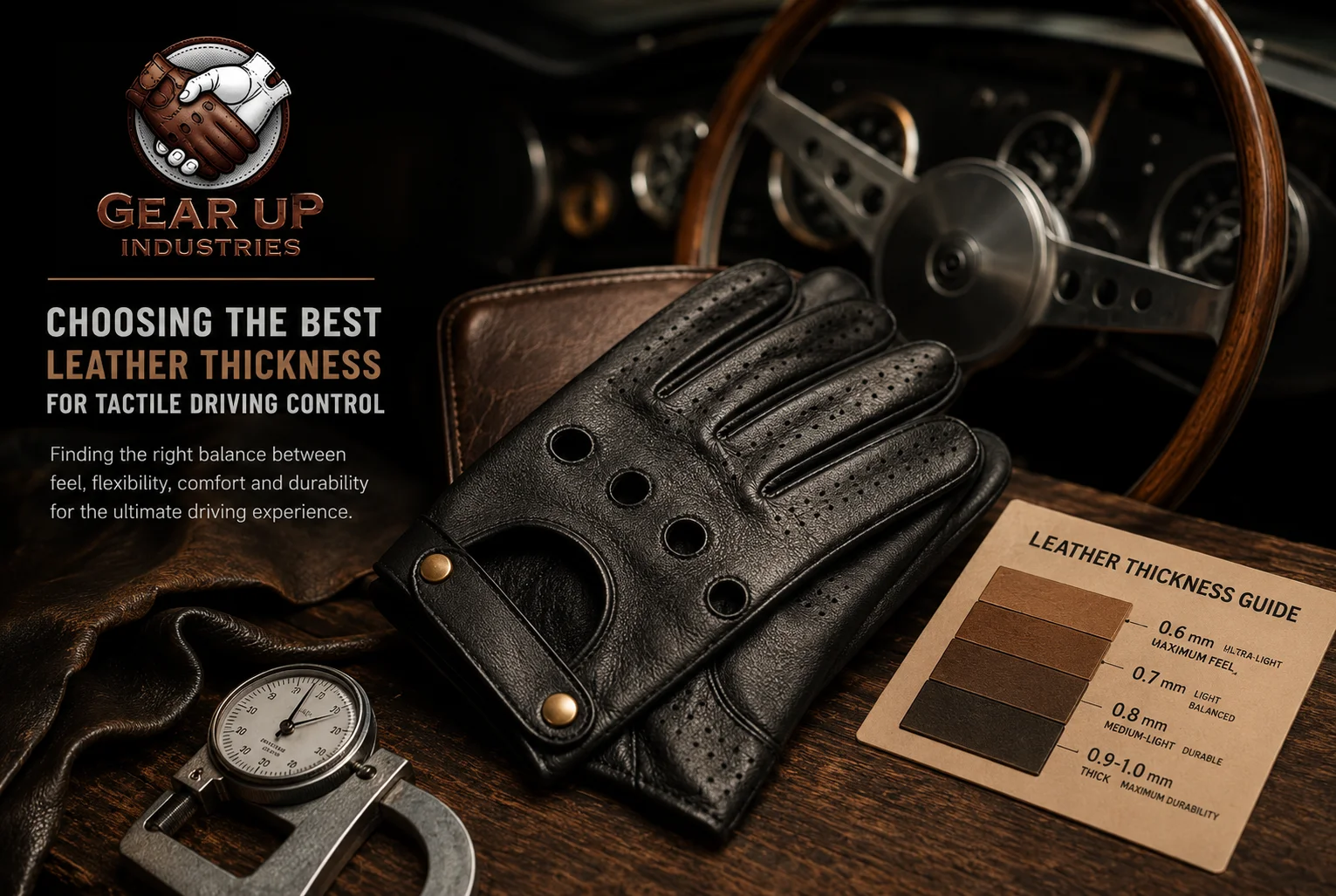
When developing a premium leather driving glove, leather thickness is one of the most important specifications to get right.
A glove that is too thick may feel stiff and reduce the driver’s connection with the steering wheel. A glove that is extremely thin may provide excellent tactile sensitivity but may not deliver the durability or structure some customers expect.
For USA glove brands, wholesalers, automotive retailers, and private-label businesses, the goal is not simply to choose the thinnest leather available. The better approach is to select a thickness that creates the right balance between tactile control, flexibility, comfort, durability, and product positioning.
This becomes particularly important when developing different driving glove collections for classic-car enthusiasts, daily drivers, luxury customers, warm-weather markets, or premium automotive lifestyle brands.
This guide explains how leather thickness affects driving-glove performance and what wholesale buyers should consider before approving a production specification.
Why Leather Thickness Matters in Driving Gloves
Driving gloves are designed to maintain a close relationship between the hand and steering wheel.
Unlike heavy-duty work gloves, they generally need to allow the fingers and palm to move naturally while preserving tactile feedback.
Thinner leather can provide greater flexibility and sensitivity, while thicker leather can add structure and durability. General glove-industry guidance commonly places lightweight driving-glove leather around the 0.6–0.8 mm range, although the appropriate specification varies by leather and application.
Thickness Affects More Than Durability
Wholesale buyers sometimes look at thickness mainly as a durability specification.
For driving gloves, that is only part of the equation.
Thickness can influence:
- Steering-wheel feedback
- Finger flexibility
- Palm sensitivity
- Overall glove weight
- Break-in behavior
- Comfort
- Breathability
- Perceived quality
- Seasonal suitability
The right specification depends on how the final glove is expected to perform.
What Leather Thickness Is Best for Driving Gloves?
There is no single thickness that is ideal for every driving glove.
However, lightweight leather in approximately the 0.6–0.8 mm range is commonly associated with flexible, tactile glove applications.
For a wholesale product developer, this range can be a useful starting point rather than a fixed rule.
Lightweight Leather: Around 0.6–0.7 mm
A lightweight specification can be suitable when tactile feedback and flexibility are the main priorities.
This type of construction can work well for:
- Premium driving gloves
- Classic motoring styles
- Warm-weather collections
- Unlined gloves
- Luxury fashion-driven products
- Sports-car enthusiasts
The thinner construction allows the glove to feel less bulky and can help preserve a closer connection between the hand and steering wheel.
Medium-Light Leather: Around 0.7–0.8 mm
Moving slightly thicker can provide a useful balance between tactile sensitivity and everyday durability.
This can be attractive for brands that want a versatile driving glove rather than an ultra-light specialty product.
A 0.7–0.8 mm specification may be considered for:
- Everyday driving
- Premium private-label collections
- Transitional seasons
- General automotive retail
- Customers who want both comfort and durability
Thicker Leather: Around 0.8 mm and Above
Thicker leather can provide additional structure and durability, but it may also change the character of a driving glove.
As leather becomes heavier or stiffer, designers need to evaluate whether the additional material reduces the flexibility and tactile feel expected from the product.
Some driver-style gloves use around 0.8 – 1.0 mm leather where greater durability is required, showing that thickness should ultimately be matched to the intended application rather than selected from a single universal standard.
How Leather Thickness Affects Tactile Driving Control
Tactile control is the ability to sense what is happening through the glove while maintaining a secure grip.
For driving gloves, this can include feeling the steering wheel’s texture, shape, movement, and pressure against the palm and fingers.
Thinner Leather and Steering Feedback
Thinner leather generally creates less material between the hand and steering wheel.
This can make it easier for the wearer to feel subtle changes in the steering wheel.
That is one reason lightweight leathers such as lambskin, hair sheep, and selected goatskin are frequently used in driving-oriented gloves. Driving-glove guides commonly emphasize soft, thin, flexible leather for maintaining sensitivity.
Thicker Leather and Reduced Sensitivity
A thicker glove is not automatically a poor driving glove.
However, additional material can create a more substantial barrier between the hand and steering wheel.
If the leather is also stiff, the glove may require more break-in time and may feel less responsive during precise hand movements.
For a product designed specifically around tactile driving control, excessive thickness can therefore work against the intended experience.
Leather Type Matters Alongside Thickness
Thickness should never be evaluated by itself.
Two leathers with the same measured thickness can feel completely different because their fiber structure, softness, stretch, finish, and tanning process may vary.
Lambskin and Hair Sheep Leather
Soft sheep-based leathers are often selected for lightweight premium gloves because of their supple hand feel.
They can be suitable for products where softness and tactile sensitivity are major selling points.
However, extremely soft leather may require more careful consideration of durability and handling.
Goatskin Leather
Goatskin can provide a useful combination of flexibility and durability.
It can be an attractive option for brands looking for a driving glove that needs to feel soft while also handling regular use.
Some current driver-glove specifications use goatskin in the approximately 0.7–0.9 mm range, illustrating how the material can be positioned between lightweight tactile performance and greater durability.
Deerskin and Other Soft Leathers
Deerskin is known for softness and flexibility, but the final result depends heavily on how the leather is processed and what thickness is selected.
The same principle applies to other specialty leathers.
The question should always be:
How does this specific leather behave at the selected thickness?
Thickness vs Flexibility in Driving Gloves
Flexibility is essential because drivers continuously move their fingers, palm, and wrist.
Why Finger Flexibility Matters
A driving glove should allow the wearer to:
- Wrap fingers around the steering wheel
- Adjust hand position
- Turn the wheel comfortably
- Operate controls
- Maintain a secure grip
- Move naturally without excessive resistance
A glove can use high-quality leather but still feel uncomfortable if the material is too rigid for its intended construction.
Pattern Design Can Change the Result
Leather thickness is only one part of glove flexibility.
The glove pattern also matters.
Finger length, palm shape, thumb construction, seam placement, gussets, perforations, and wrist design can all influence how easily the glove moves with the hand.
This means a manufacturer should evaluate the complete glove construction, rather than approving leather thickness separately.
Does Thinner Leather Always Mean Better Driving Control?
No.
This is an important distinction for wholesale buyers.
A very thin glove can provide excellent sensitivity, but the product still needs enough strength and structure for its intended customer.
The Durability Trade-Off
As leather becomes thinner, the product developer needs to consider:
- Abrasion
- Seam stress
- Fingertip wear
- Palm friction
- Stretch
- Long-term shape retention
The best specification is therefore usually a balanced specification, not simply the minimum possible thickness.
Match Thickness to the Customer
A luxury weekend-driving customer may prioritize tactile sensitivity.
A customer using gloves for frequent daily driving may place greater importance on durability.
A classic-car enthusiast may care equally about tactile feel and authentic styling.
The product specification should reflect those differences.
How Lining Changes the Thickness Decision
Leather thickness becomes even more important when a driving glove includes a lining.
Unlined Driving Gloves
Unlined gloves allow the wearer to experience the leather more directly.
This construction is particularly suitable when the product is intended to feel lightweight and responsive.
Because there is no lining adding another layer between the hand and leather, the outer leather specification becomes especially important.
Lined Driving Gloves
A lining adds another layer inside the glove.
This can increase comfort and warmth, but it also changes the overall feel and internal volume.
For a lined driving glove, the manufacturer should consider the leather thickness and lining together rather than independently.
For a brand focused heavily on tactile driving control, a lightweight leather with an appropriate unlined construction may be a more natural starting point.
How Perforations Affect Driving Glove Performance
Perforations are another feature that should be evaluated alongside leather thickness.
Breathability for Warm-Weather Driving
Perforated leather can improve airflow through the glove and may be particularly useful in warmer climates.
This can be valuable for USA brands targeting customers in states with hot summers.
A lightweight perforated leather glove can create a noticeably different product proposition from a thicker, fully enclosed glove.
Do Not Compromise Structural Integrity
However, perforations remove small areas of leather.
Manufacturers should therefore consider their size, placement, spacing, and relationship to seams and stress points.
A premium design should balance ventilation with structural integrity.
Use Perforations Strategically
Common design areas can include:
- Back of the hand
- Fingers
- Between fingers
- Knuckle area
The exact placement should be determined according to the glove pattern and intended use.
Test the Finished Glove
Do not judge perforation performance from the pattern alone.
The completed glove should be evaluated for flexibility, comfort, fit, stitching, and durability before bulk production.
Choosing Leather Thickness for Different USA Markets
USA buyers should also consider regional climate and customer behavior.
Warm-Weather Markets
For warmer regions, lightweight and breathable construction can be attractive.
Potential specifications include:
- Lightweight leather
- Unlined construction
- Perforated panels
- Breathable patterns
- Shorter wrist construction
The goal is to minimize unnecessary bulk.
Cooler Markets
In colder areas, customers may value warmth more than maximum tactile sensitivity.
A brand may therefore choose:
- Slightly heavier leather
- Lining
- Longer cuffs
- More enclosed designs
The exact leather specification should still maintain enough flexibility for comfortable driving.
Nationwide Retail Collections
Brands selling across the USA do not necessarily need one universal construction.
A more strategic assortment could include:
Classic lightweight model:
Thin unlined leather for tactile driving.
Premium everyday model:
Balanced leather thickness for durability and comfort.
Cold-weather model:
Moderately heavier leather combined with suitable lining.
This allows retailers to address multiple customer needs without forcing one specification into every market.
Leather Thickness and Private Label Product Development
For private-label brands, leather thickness should be finalized during product development.
Questions to Ask Your Manufacturer
Before approving a specification, ask:
- What thickness is recommended for the selected leather?
- What tolerance range can production maintain?
- How does the leather behave after cutting?
- How much stretch should be expected?
- Is the leather suitable for unlined construction?
- Would perforations affect the selected specification?
- What lining options are compatible?
- How does thickness affect the final glove fit?
- Can samples be produced in multiple thicknesses?
- How will the finished glove be inspected?
These questions can help a buyer compare prototypes before committing to bulk manufacturing.
Request Multiple Thickness Samples
One of the most practical approaches is to test two or three versions.
For example:
- Lightweight sample
- Mid-weight sample
- Slightly heavier sample
Then compare them on the steering wheel.
Evaluate:
- Grip
- Finger movement
- Palm sensitivity
- Steering feedback
- Comfort
- Leather softness
- Break-in behavior
- Overall weight
This gives the product team a much better basis for selecting the final specification than relying on numbers alone.
Quality Control for Leather Thickness
Thickness should also be included in the production quality-control process.
Maintain Consistency Across the Hide
Leather is a natural material, so thickness can vary across different areas of a hide.
A reliable manufacturing process should account for this variation when cutting glove panels.
Wholesale buyers should discuss acceptable thickness tolerances before production.
Inspect Critical Glove Areas
Pay particular attention to:
- Palm
- Fingertips
- Thumb
- Back of hand
- Cuff
- Seam areas
Consistency helps ensure that the final product feels balanced rather than noticeably different from one section to another.
A Practical Leather Thickness Guide for Wholesale Buyers
| Approximate Thickness | General Character | Potential Driving-Glove Positioning |
| 0.5–0.6 mm | Very lightweight and sensitive | Specialty premium/tactile designs |
| 0.6–0.7 mm | Lightweight and flexible | Classic and premium driving |
| 0.7–0.8 mm | Balanced feel and durability | Everyday premium driving |
| 0.8–1.0 mm | More substantial | Durable or colder-weather designs |
| 1.0 mm+ | Heavier construction | Usually less suitable for pure tactile driving |
These ranges are planning references, not universal manufacturing standards. Leather species, finish, tanning, construction, lining, and pattern can significantly change how a glove feels at the same measured thickness.
How Gearup Industries Can Help With Driving Glove Development
For USA brands developing private-label or wholesale driving gloves, selecting leather thickness is only one part of the product-development process.
The final specification should connect:
- Leather type
- Leather thickness
- Glove pattern
- Lining
- Perforation
- Stitching
- Closure
- Size range
- Branding
- Packaging
Gearup Industries can help businesses develop leather driving glove specifications around their target market and product positioning.
Brands can explore the leather driving gloves collection when planning a wholesale product range and review crochet leather driving gloves when a classic or heritage-inspired design is part of the collection.
FAQs About Leather Thickness for Driving Gloves
What is the best leather thickness for driving gloves?
There is no single thickness that works for every driving glove. Lightweight leather around 0.6–0.8 mm is commonly used as a starting range for flexible, tactile applications, but the ideal specification depends on leather type, construction, and intended use.
Is thinner leather better for tactile driving control?
Generally, thinner leather can provide greater tactile sensitivity because there is less material between the hand and steering wheel. However, extremely thin leather may sacrifice durability, so the final specification needs to balance both factors.
Is 0.6 mm leather good for driving gloves?
It can be suitable for lightweight, tactile driving gloves, particularly when paired with soft leather and an appropriate pattern. The manufacturer should still test the finished glove for durability and fit.
Is 0.8 mm leather too thick for driving gloves?
Not necessarily. Around 0.8 mm can provide a useful balance between tactile feel and durability for some driving-glove constructions. The leather type and finishing process also influence the final feel.
Which leather is best for tactile driving gloves?
Soft, flexible leathers such as lambskin, hair sheep, selected goatskin, and appropriately processed deerskin can work well. The best option depends on the brand’s desired balance of sensitivity, durability, appearance, and price.
Does lining reduce tactile sensitivity?
A lining adds another layer between the hand and outer leather, which can change the direct feel of the glove. Unlined construction is often preferred when maximum tactile connection is a major product objective.
Do perforations improve driving glove comfort?
Perforations can increase airflow and may improve comfort in warmer conditions. Their placement and size should be carefully designed so that ventilation does not compromise the glove’s structure.
Should wholesale buyers request different leather thickness samples?
Yes. Comparing multiple prototypes can help buyers understand how thickness affects steering feedback, flexibility, comfort, and durability before bulk production.
How should leather thickness be checked during production?
Thickness should be measured according to the agreed specification and tolerance, with attention to variation across the hide and finished glove panels. The final glove should also be evaluated for feel and construction quality.
Can Gearup Industries produce custom leather driving gloves?
Brands can discuss custom leather driving glove requirements with Gearup Industries, including leather selection, construction, design details, branding, and wholesale product specifications.
Final Takeaway
The best leather thickness for driving gloves is not simply the thinnest leather a manufacturer can produce.
The right specification is the one that provides the intended balance of tactile feedback, flexibility, comfort, durability, and overall product positioning.
For many lightweight driving applications, approximately 0.6–0.8 mm can be a useful starting range, but the final decision should be based on the specific leather and finished glove construction.
For USA wholesale buyers, the smartest approach is to test physical samples, compare different thicknesses, evaluate them on an actual steering wheel, and then finalize the specification based on the target customer.
When leather thickness, pattern, lining, perforation, and leather type are designed together, a driving glove can deliver the tactile experience customers expect without sacrificing the durability required for regular use.