

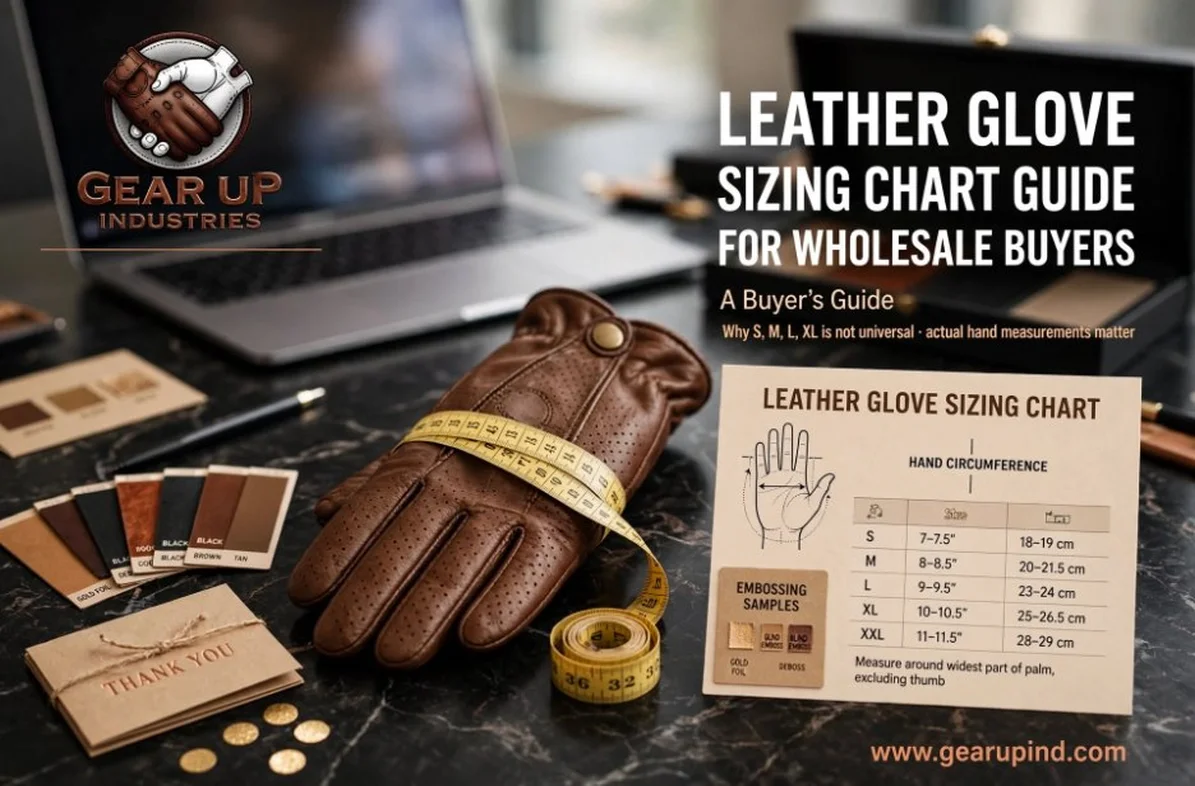
When you’re sourcing leather gloves for a wholesale or private-label business, sizing is one of the specifications you cannot afford to leave unclear.
A leather glove may use premium material and excellent stitching, but if the sizing is inconsistent, the product can still create customer complaints, exchanges, and unnecessary inventory problems.
For wholesale buyers in the United States, this becomes even more important because suppliers may use different definitions for Small, Medium, Large, and XL. Current glove sizing charts from U.S. brands demonstrate that the same letter size can correspond to different hand measurements depending on the manufacturer and glove category.
That is why a professional buyer should not simply ask a manufacturer for “S, M, L, and XL.” Instead, the order specification should include actual hand measurements, the size system being used, and an approved sample.
This guide explains how to build and use a leather glove sizing chart for wholesale orders, how to measure hand size, and what U.S. buyers should confirm before moving into bulk production.
Why Glove Sizing Matters for Wholesale Buyers
For a consumer purchasing one pair of gloves, incorrect sizing may mean a return or exchange.
For a wholesale buyer, the consequences can be much larger.
Imagine ordering 2,000 pairs of leather gloves and discovering after production that the manufacturer’s Medium is noticeably smaller than the Medium size your U.S. customers expect.
The problem is no longer one pair.
It can affect an entire inventory allocation.
Sizing Affects More Than Customer Comfort
A consistent size system helps a wholesale buyer manage:
- Product development
- Sample approval
- Size assortment planning
- Product listings
- Retail packaging
- Inventory forecasting
- Quality control
- Customer expectations
- Reorder consistency
For private-label brands, the sizing chart also becomes part of the product specification.
Letter Sizes Are Not Universal
One of the biggest mistakes in international glove sourcing is assuming that M always means the same measurement.
It doesn’t.
For example, current sizing references show different circumference ranges for men’s and women’s gloves across major brands. Some charts use numbered glove sizes, while others use XS–XXL.
Therefore, a wholesale buyer should treat S, M, L, and XL as labels, not measurements.
The actual hand circumference should be the reference point.
Standard Leather Glove Size Chart for Wholesale Planning
The following chart can be used as a starting framework for product development, but it should not replace the manufacturer’s approved size chart.
| Size | Approx. Hand Circumference | Approx. Circumference | Typical Use |
| XS | 6.0–7.0 in | 15.2–17.8 cm | Smaller hands |
| S | 7.0–8.0 in | 17.8–20.3 cm | Small adult hands |
| M | 8.0–9.0 in | 20.3–22.9 cm | Medium adult hands |
| L | 9.0–10.0 in | 22.9–25.4 cm | Larger adult hands |
| XL | 10.0–11.0 in | 25.4–27.9 cm | Extra-large hands |
| XXL | 11.0–12.0 in | 27.9–30.5 cm | Very large hands |
Important: This is a planning chart, not a universal industry standard. Published U.S. glove charts vary by brand and product category, which is why buyers should approve the manufacturer’s actual measurements before bulk production.
Why Wholesale Buyers Should Use Inches and Centimeters
If you are sourcing from an overseas factory for the U.S. market, provide both units.
For example:
Medium: 8.0–9.0 inches / 20.3–22.9 cm
This reduces confusion between a U.S. buyer, manufacturer, packaging supplier, and product team.
It is particularly useful when the same glove will be sold through multiple retail or e-commerce channels.
Numbered Sizes vs. Letter Sizes
Some glove manufacturers use numbers such as 7, 8, 9, 10, and 11, while others use XS, S, M, L, XL, and XXL.
A number-based system is often tied directly to hand circumference, while letter sizing groups measurements into ranges. Current glove sizing references show both approaches in use.
For a wholesale program, either approach can work.
The important point is consistency.
Choose One Primary Size System
If your U.S. retail customers are accustomed to S–XL, using letter sizes may make the product easier to merchandise.
If your buyer specification uses numerical glove sizes, maintain that system consistently across:
- Samples
- Purchase orders
- Product labels
- Packaging
- Size charts
- QC documents
Don’t Change Size Definitions Between Orders
A Medium from your first production run should not become a substantially different Medium six months later.
Use the Approved Measurement as the Reference
The actual measurement, not the letter printed on the label should be the manufacturing reference.
How to Measure Hand Size for a Leather Glove
Accurate sizing begins with accurate measurement.
For most glove sizing systems, the primary measurement is the circumference around the hand, excluding the thumb. Some sizing guides also use hand length as a secondary measurement.
Step 1:- Measure Hand Circumference
Use a flexible measuring tape.
Wrap it around the widest part of the palm, generally across the knuckle area, while excluding the thumb.
Keep the tape snug without squeezing the hand.
Record the result in inches and centimeters.
Step 2:- Measure Hand Length
Measure from the wrist crease or base of the hand to the tip of the middle finger.
Hand length can help identify unusual proportions where circumference alone does not tell the complete story.
Some current U.S. sizing guides specifically recommend using both circumference and length when determining glove size.
Step 3:- Measure the Dominant Hand
For a standard sizing process, measuring the dominant hand can be useful because hand dimensions may differ slightly between hands.
The Glove Manufacturers Association’s measurement guidance recommends using the dominant hand when determining glove size.
For a wholesale product, however, the manufacturer should define the exact measurement protocol used for its production chart.
Men’s vs. Women’s Leather Glove Sizing
Wholesale buyers should avoid treating men’s and women’s gloves as identical products with different colors.
The pattern and sizing proportions may be different.
Men’s Leather Glove Sizing
Men’s glove charts generally use larger hand circumference ranges than women’s charts.
For example, Cole Haan currently lists men’s glove sizes beginning around 8 inches for Small and progressing through larger circumference ranges, while its women’s chart starts at smaller measurements.
The exact ranges vary between brands.
For a wholesale men’s leather glove line, confirm:
- Palm circumference
- Finger length
- Thumb proportions
- Overall glove length
- Size increments between grades
Women’s Leather Glove Sizing
Women’s leather gloves generally use smaller circumference ranges, but the same caution applies: there is no single universal S, M, or L measurement.
For example, current women’s sizing charts from U.S. brands place Medium around different circumference ranges depending on the product and brand.
For a private-label women’s collection, approve the actual pattern and measurements rather than simply requesting the factory’s standard women’s S–XL.
Why Gender-Specific Grading Matters
A glove pattern should not simply be scaled up or down mechanically.
The relationship between:
- Palm width
- Finger length
- Thumb length
- Finger circumference
- Wrist opening
can affect the final fit.
This becomes particularly important for fitted leather gloves, where excess material is more noticeable.
Leather Glove Sizing by Product Category
Sizing requirements can also change according to the type of leather glove being developed.
Leather Driving Gloves
Driving gloves are generally designed around a close, flexible fit.
The buyer should evaluate the relationship between palm circumference and finger length during sampling.
If you’re developing a private-label driving glove for the U.S. market, the size chart should be tested on the actual pattern rather than copied from a generic work-glove chart.
For brands developing different styles, Gearup Industries’ leather driving gloves category can be used as the product reference when defining the type of glove being developed.
Fingerless Leather Driving Gloves
Fingerless styles have a different fit consideration because the fingertips are open.
The palm circumference and finger-opening position become more important than full-finger length.
This means a size chart designed for full-finger gloves should not automatically be copied for a fingerless design.
Leather Golf Gloves
Golf gloves typically require a close fit because excess material can interfere with tactile feel and grip.
Current golf-glove fitting guidance from G/FORE, for example, describes the intended fit as snug, with leather taut across the palm and back of the hand.
For wholesale buyers developing golf gloves, sizing should therefore be evaluated together with:
- Palm circumference
- Finger length
- Closure position
- Leather stretch
- Hand orientation
- Regular vs. cadet proportions where applicable
If golf gloves are part of your product line, the leather golf gloves category is the more relevant product cluster for this sizing discussion.
What Wholesale Buyers Should Include in a Glove Size Specification
A professional purchase specification should go beyond “S–XL.”
Minimum Sizing Information
Include:
- Size label
- Hand circumference
- Hand length
- Unit of measurement
- Men’s or women’s designation
- Glove pattern reference
- Finger-length requirements
- Tolerance range
- Approved sample reference
This gives the factory measurable requirements.
Add Measurement Tolerances
Leather is a natural material, so a production specification should recognize reasonable manufacturing variation.
The important point is to establish the acceptable tolerance with the manufacturer before production.
For example, your specification might state:
Size M – Target palm circumference: 8.5 inches agreed production tolerance: ±X
The exact tolerance should be agreed during product development rather than invented after production.
Why Tolerance Matters in Bulk Production
Suppose your approved Medium measures correctly but production pairs vary noticeably.
Even if every pair carries an “M” label, the customer may experience them as different sizes.
A documented tolerance makes QC more objective.
How to Build a Wholesale Glove Size Assortment
A sizing chart tells you what each size means.
A size assortment tells you how many pairs to order in each size.
These are different decisions.
Start With Your Sales Data
If you already sell gloves in the United States, use historical sales by size.
For example, analyze:
- Units sold by size
- Return rate by size
- Seasonal changes
- Men’s vs. women’s demand
- Product-specific demand
This is more reliable than copying another supplier’s assortment.
New Brands Need a Testable Assortment
For a new private-label brand without historical sales data, the initial assortment should be treated as a test.
Avoid assuming that one universal ratio will work for every product.
Your driving glove customers may have a different size distribution from your golf glove customers.
Your men’s collection may also perform differently from your women’s collection.
Keep the Size Range Consistent
Once you establish the core range, keep the labeling consistent across:
- Website
- Packaging
- Hangtags
- Purchase orders
- Wholesale catalogs
- Reorders
Consistency becomes especially important when a U.S. brand changes manufacturers.
How Leather Affects Glove Fit
Sizing is not determined by measurements alone.
Leather characteristics also influence how a glove feels.
Soft Leather
Soft leather can conform to the hand with wear.
This means a glove that feels snug during initial fitting may change slightly as it is used.
Firmer Leather
Firmer leather may retain its original shape more strongly.
The pattern therefore needs to provide appropriate room for the intended use.
Lined vs. Unlined Gloves
A lining changes the interior space available to the hand.
For example, if a brand develops both lined and unlined versions of the same glove, the factory should confirm whether the pattern or fit needs adjustment.
This is another reason not to reuse a size chart blindly across different constructions.
Wholesale Glove Sizing Quality Control
Size consistency should be checked before the finished order reaches your U.S. warehouse.
Check the Approved Sample
The approved sample should establish the reference for:
- Palm measurement
- Finger length
- Thumb length
- Cuff opening
- Overall dimensions
- Fit
Measure Production Samples
During bulk QC, measure representative pairs from each size.
Do not assume that an “M” label means the glove automatically meets the agreed dimensions.
Compare Across Sizes
Look at the grading between S, M, L, and XL.
The sizes should progress logically according to the approved specification.
Check Both Hands Where Relevant
If your product is sold as left- and right-hand specific, as can occur with golf gloves, the size specification should identify the intended hand.
This is particularly important when developing golf products because current golf brands may offer hand-specific and cadet sizing options.
Common Leather Glove Sizing Mistakes Wholesale Buyers Make
Mistake 1:- Assuming Every Medium Is the Same
It isn’t.
Published sizing charts from different U.S. brands demonstrate that Medium can correspond to different hand measurements.
Mistake 2:- Using Only a Generic Size Chart
A generic chart is useful for planning.
It should not replace your supplier’s approved measurement specification.
Mistake:- 3 Ignoring Finger Length
Two gloves can have similar palm circumference but feel completely different if the finger proportions are different.
Mistake 4:- Changing Factories Without Rechecking Measurements
If you move production from one manufacturer to another, do not assume that the new factory’s S, M, L, and XL correspond exactly to the previous supplier.
Re-measure and approve a new sample.
Mistake 5:- Treating All Glove Categories the Same
A leather driving glove, golf glove, and lined winter glove can require different fit considerations.
The size label alone does not define the fit.
How Gearup Industries Can Support Custom Glove Sizing
For wholesale and private-label buyers, sizing should be discussed during product development rather than after production starts.
Gearup Industries works with B2B buyers on leather glove manufacturing, including product development, sampling, sizing, customization, and private-label requirements. The company’s manufacturing brief specifically identifies sizing customization and sample production/prototyping among its B2B capabilities.
A buyer developing a custom glove can therefore provide:
- Target size range
- Hand circumference measurements
- Finger dimensions
- Men’s/women’s requirements
- Existing sample
- Technical drawings
- Product photographs
- Approved fit references
This gives the manufacturer a clearer starting point.
Use a Sample Before the Bulk Order
The sample stage is where sizing problems should be discovered.
Test the sample for:
- Palm fit
- Finger length
- Thumb movement
- Cuff fit
- Overall comfort
- Visual proportions
Once the fit is approved, use that sample and measurement sheet as the reference for production.
Final Wholesale Leather Glove Sizing Checklist
Before approving your next bulk order, confirm these points:
- Size labels are clearly defined
- Circumference is provided in inches
- Centimeter conversions are included
- Hand-length measurements are documented where needed
- Men’s and women’s sizing are separated where applicable
- The actual glove pattern has been sampled
- Production tolerances are agreed
- Size grading has been reviewed
- The approved sample is documented
- Bulk QC includes dimensional checks
- Product packaging uses the same size definitions
- Reorders will follow the same approved measurements
Frequently Asked Questions
What is the standard leather glove size chart for wholesale buyers?
There is no single universal chart. A practical starting framework is to organize sizes around hand circumference, but the final S–XXL measurements should be approved with the manufacturer because sizing varies between brands and glove categories.
How do you measure hand size for leather gloves?
Measure around the widest part of the hand, excluding the thumb. Many sizing guides also recommend measuring from the wrist/base of the hand to the middle-finger tip.
Are men’s and women’s leather glove sizes different?
Yes. Men’s and women’s glove charts generally use different circumference ranges and may also have different pattern proportions. Always approve the actual measurements for the product you are manufacturing.
Is glove size based on hand circumference or length?
Circumference is commonly used as the primary measurement, while hand length can be used as an additional fit reference. Some manufacturers use both.
Can a wholesale buyer request custom glove sizing?
Yes, custom sizing can be discussed during product development. The requirement should be documented through measurements, a pattern or sample, and an approved specification.
Should I use the manufacturer’s standard size chart for my private-label brand?
Not automatically. If the factory’s standard chart matches your target market and approved fit, you may use it. Otherwise, provide your own measurements and have the manufacturer develop samples against them.
How should a buyer handle sizing when changing manufacturers?
Treat the new factory as a new sizing approval. Provide the previous approved measurements and sample where possible, then compare the new manufacturer’s sample against them before bulk production.
Why is sizing consistency important for wholesale leather gloves?
Because inconsistent sizing can affect customer satisfaction, returns, inventory planning, and future reorders. A documented measurement specification gives the buyer and manufacturer a shared quality reference.
Conclusion
A leather glove sizing chart is not simply a table to place on an e-commerce product page.
For wholesale buyers, it is part of the manufacturing specification.
The safest approach is to define sizes using actual hand measurements, confirm the fit through sampling, document acceptable production tolerances, and use the approved measurements consistently across labels, packaging, QC, and future reorders.
For U.S. brands sourcing leather gloves internationally, this approach also prevents one of the most common sourcing problems: assuming that an S, M, L, or XL means exactly the same thing at every factory.
When sizing is defined clearly from the beginning, your manufacturer has a measurable target and your wholesale customers have a much more predictable product to buy.