

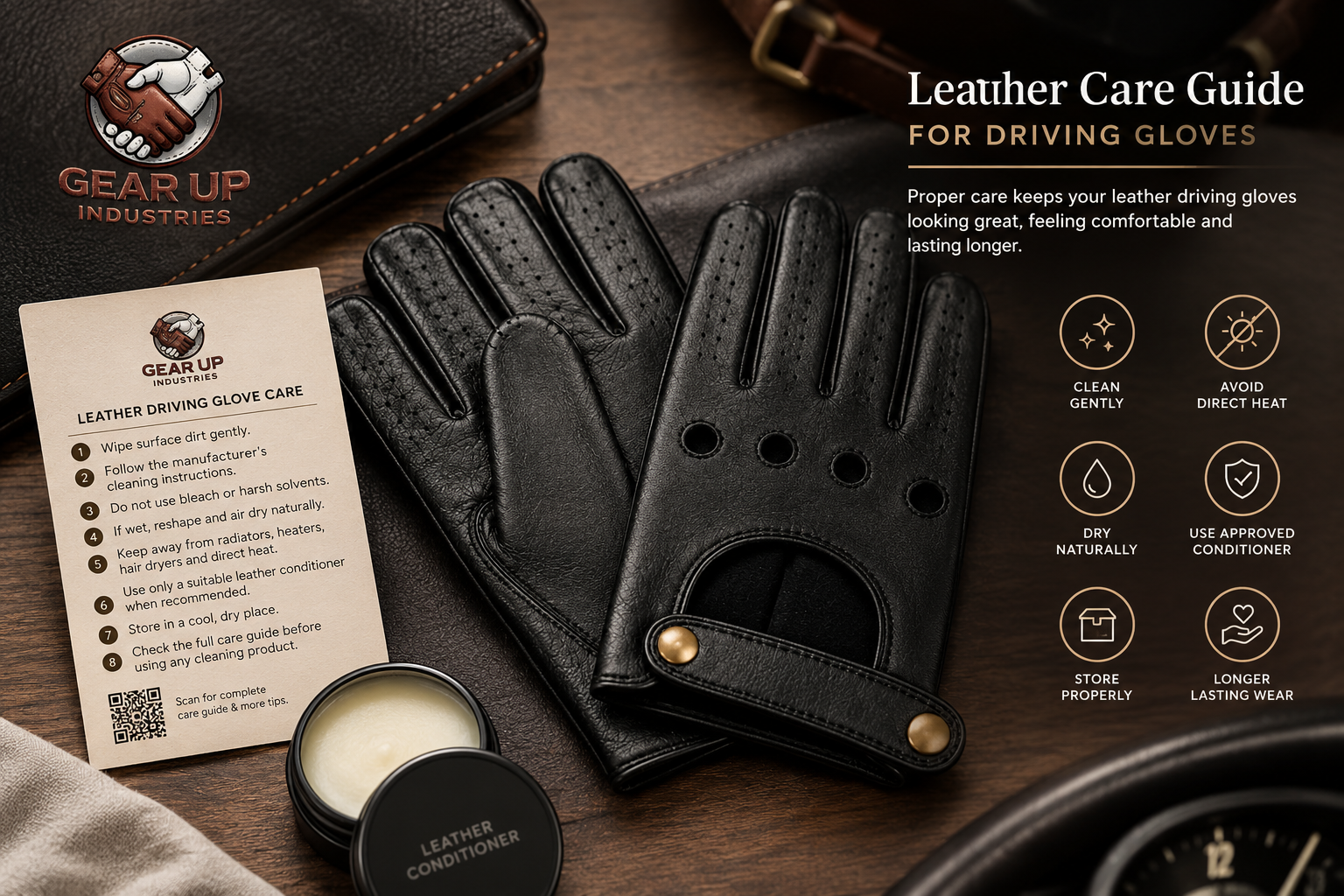
Premium leather driving gloves are designed to deliver comfort, style, and performance, but proper care plays an important role in maintaining those qualities over time.
From regular driving to everyday handling, gloves can be exposed to sweat, dust, moisture, friction, and heat. Without the right care, leather may gradually lose its softness, develop stains, become dry, or lose its original shape.
For USA retail brands, private-label businesses, and automotive lifestyle retailers, providing customers with simple and accurate care instructions can add value beyond the initial purchase. It helps customers understand how to protect their gloves and gives the brand an opportunity to demonstrate attention to quality and product support.
A well-planned leather care guide should cover the essentials—from gentle cleaning and natural drying to conditioning, storage, and the common mistakes customers should avoid.
In this guide, we’ll explain the key leather care practices retail brands can share with customers to help them get longer-lasting performance and better value from their driving gloves.
Why Leather Care Matters for Driving Glove Retailers
Leather is a natural material, and different leather types can respond differently to moisture, cleaning products, heat, and conditioning.
A good care routine helps customers preserve the qualities they originally valued when purchasing the gloves.
For a retail brand, this matters for several reasons:
- Better customer satisfaction
- Fewer avoidable product complaints
- Longer product life
- Better customer reviews
- Stronger premium positioning
- More useful post-purchase support
- Greater customer confidence in leather products
Established glove makers also emphasize careful drying and appropriate cleaning methods rather than treating leather gloves like ordinary washable textiles.
Care Instructions Are Part of the Product Experience
A customer buying a premium pair of leather driving gloves may not automatically know how to maintain them.
If the product page only says “genuine leather” without explaining care, customers may use unsuitable cleaners, excessive water, or direct heat.
Retail brands can prevent many of these problems by including a short care card inside the packaging and a more detailed guide on their website.
Why This Is Especially Important for Driving Gloves
Driving gloves have a unique use environment.
They can come into contact with:
- Steering-wheel surfaces
- Hand perspiration
- Dust and dirt
- Automotive cleaners
- Sunlight
- Rain
- Interior heat
- Frequent friction
Dents specifically notes that the surface of new leather driving gloves may initially feel slippery and that this can improve with use as the leather softens. It also warns that some steering-wheel cleaning products can contribute to a slippery surface.
Start With the Right Cleaning Advice
One of the biggest mistakes retail brands can make is giving generic cleaning instructions for every leather glove.
The appropriate method depends on the leather, finish, lining, and manufacturer’s specifications.
Remove Surface Dirt First
For light dust and surface dirt, customers should generally start with the least aggressive method.
A soft, clean cloth can be used to gently remove loose dirt.
There is no reason to immediately soak the entire glove for a small surface mark.
The basic principle should be:
Start gently and use as little moisture as practical.
For some leather gloves, manufacturers recommend gentle cleaning with a damp cloth or suitable mild soap rather than aggressive treatment.
Avoid Aggressive Cleaning Products
Retail brands should warn customers against experimenting with household chemicals.
Avoid recommending:
- Bleach
- Strong solvents
- Harsh detergents
- Abrasive cleaners
- Alcohol-based household cleaners
- Petroleum-based chemicals
- Unapproved leather treatments
BMW Motorrad, for example, specifically warns against aggressive cleaning agents such as solvents and recommends checking the manufacturer’s care instructions for leather gloves.
Always Test a Leather Product First
If a customer plans to use a leather cleaner or conditioner, advise them to test it on a small, less visible area first.
This is particularly important for:
- Light-colored leather
- Aniline leather
- Suede or nubuck
- Thin glove leather
- Specialty finishes
Hestra’s current care guidance similarly recommends testing leather lotion on a small patch and notes that some light-colored leather may darken slightly after treatment.
How Customers Should Clean Leather Driving Gloves
For retail brands, the safest approach is to provide a simple, product-specific cleaning process.
Step 1 — Check the Manufacturer’s Instructions
Before recommending washing or soaking, customers should check the care label or instructions supplied with the glove.
Not every leather is designed to be treated in the same way.
Some glove leathers can tolerate gentle washing, while others may require specialized cleaning.
Pittards, for example, provides washable care instructions for certain leather glove products, while other leather-glove makers recommend more limited surface cleaning.
Step 2 — Clean Gently
For light surface dirt, use a clean cloth or an appropriate leather-cleaning method specified by the manufacturer.
Do not aggressively scrub the leather.
The goal is to remove contamination without unnecessarily disturbing the leather’s finish.
Step 3 — Remove Excess Moisture
If the glove becomes damp during cleaning, gently remove excess moisture.
Do not twist, wring, or aggressively pull the glove.
Some professional glove-care guidance specifically advises against rubbing, pulling, or wringing leather gloves.
The Right Way to Dry Leather Driving Gloves
Drying is one of the most important parts of leather glove care.
A common mistake is attempting to speed up the process with artificial heat.
Let Gloves Dry Naturally
If leather driving gloves become wet, allow them to dry gradually at room temperature in a well-ventilated area.
Avoid:
- Radiators
- Hair dryers
- Clothes dryers
- Direct sunlight
- Heaters
- Other intense heat sources
Multiple established glove-care guides recommend natural drying and warn against direct heat because excessive heat can affect leather and glove shape.
Restore the Shape While Drying
Leather can change shape when wet.
Customers should avoid leaving wet gloves compressed in a pile or folded awkwardly.
Instead, gently restore the gloves to their natural shape while they dry.
Some glove-care instructions also recommend putting gloves back on briefly while they are drying so the leather can return toward the wearer’s hand shape.
Why Retail Brands Should Highlight the No-Heat Rule
“Do not use direct heat” is one of the most useful instructions a retail brand can put on a care card.
It is simple, memorable, and helps prevent a common mistake.
A short message such as “Air dry naturally. Never place leather gloves on a radiator or use a hair dryer” can be more useful than a long technical explanation.
Should Customers Condition Leather Driving Gloves?
Conditioning can help maintain some leather products, but retail brands should avoid recommending it automatically for every glove.
The correct conditioner depends on the leather type and finish.
When Conditioning May Be Appropriate
A suitable leather conditioner can help certain leather products maintain flexibility and reduce excessive dryness.
However, customers should only use products specifically appropriate for their glove leather.
Pittards recommends natural leather conditioner for some of its leather glove products, while Hestra warns against treating certain thin or porous dress glove leathers because treatment may produce an uneven or blotchy appearance.
Do Not Over-Condition
More conditioner does not necessarily mean better leather care.
Excessive product can change the leather’s appearance or feel and may interfere with the finish.
For a retail brand, a safer customer message is:
Use only a small amount of a manufacturer-approved leather conditioner when the leather requires it.
Conditioning Should Follow the Leather Specification
When developing private-label driving gloves, the brand and manufacturer should agree on recommended care before printing care instructions.
This is especially important when using:
- Thin lambskin
- Hairsheep leather
- Nappa leather
- Suede
- Nubuck
- Specialty finishes
- Water-resistant treated leather
How to Care for Different Leather Driving Glove Styles
Not every driving glove needs the same care messaging.
Smooth Leather Driving Gloves
Smooth leather is often relatively straightforward to maintain when the manufacturer-approved cleaning method is followed.
Retail brands can focus on:
- Gentle surface cleaning
- Suitable conditioning
- Natural drying
- Proper storage
Perforated Leather Driving Gloves
Perforated driving gloves require additional attention because the leather contains small ventilation holes.
Customers should avoid aggressive scrubbing and should make sure the gloves dry completely after exposure to moisture.
Unlined Leather Driving Gloves
Unlined gloves have direct leather contact with the hand, making sweat and oils particularly relevant.
Customers who wear them frequently should allow the gloves to air out between uses.
This can be especially useful for customers using driving gloves regularly during warm weather.
Lined Leather Driving Gloves
Lined gloves require attention to both the outer leather and inner lining.
Customers should not assume that because the lining is fabric, the entire glove can be machine washed.
The care instructions for the complete glove should take priority.
How Customers Should Store Leather Driving Gloves
Proper storage is often overlooked.
Store Gloves in a Cool, Dry Place
When the gloves are not being used, store them somewhere clean, dry, and away from excessive heat.
Avoid leaving them:
- On a hot dashboard
- Near a heater
- In direct sunlight
- In a damp storage area
- Compressed under heavy items
Keep the Pair Together
Retail brands can also recommend storing the gloves together rather than separately.
This sounds simple, but it helps customers maintain an organized product and reduces the likelihood of one glove becoming lost or damaged.
Premium Packaging Can Support Proper Storage
For premium leather driving gloves, packaging can become part of the care experience.
A brand can include:
- Branded storage pouch
- Care card
- Tissue wrapping
- Product information
- Leather-care instructions
This adds perceived value while giving customers practical information.
Keep Care Instructions Easy to Find
Do not bury important care information in a long warranty document.
Put a short version inside the package and a complete version on the product page.
That gives customers access to the information both immediately after purchase and later when they need it.
Common Leather Driving Glove Care Mistakes
A good retail care guide should tell customers what not to do.
Mistake 1 — Machine Washing Without Checking
Some leather gloves can be washable, but others should not be treated this way.
Never assume that all leather driving gloves are machine washable.
Mistake 2 — Using a Hair Dryer
Artificial heat can be damaging.
Natural drying is the safer default unless the manufacturer specifically provides different instructions.
Mistake 3 — Leaving Wet Gloves in a Car
A glove left wet inside a warm vehicle may experience an unfavorable drying environment.
Customers should remove wet gloves and allow them to dry properly.
Mistake 4 — Using the Wrong Conditioner
A conditioner designed for one leather finish may not be suitable for another.
Always follow the glove manufacturer’s recommendation.
Mistake 5 — Scrubbing Stains Aggressively
Aggressive rubbing can affect the leather’s finish.
Light cleaning should be gentle, while serious stains may require professional leather cleaning.
Create a Leather Care Card for Your Retail Brand
One of the easiest ways to improve customer education is to include a branded care card with every pair.
What to Put on the Care Card
Keep the instructions short.
A practical care card could say:
Leather Driving Glove Care
- Wipe surface dirt gently.
- Follow the manufacturer’s cleaning instructions.
- Do not use bleach or harsh solvents.
- If wet, reshape and air dry naturally.
- Keep away from radiators, heaters, hair dryers, and direct heat.
- Use only a suitable leather conditioner when recommended.
- Store in a cool, dry place.
- Check the full care guide before using any cleaning product.
This gives customers useful information without overwhelming them.
Add a QR Code to the Full Care Guide
A modern retail brand can place a QR code on the care card that directs customers to the brand’s website.
The online page can include:
- Detailed cleaning instructions
- Video demonstrations
- Leather information
- Warranty information
- Frequently asked questions
- Contact information
This also gives the brand an opportunity to maintain the information if care recommendations change.
Leather Care and Private Label Driving Gloves
Care instructions should be considered during product development, not after manufacturing is finished.
When a USA brand works with a private-label manufacturer, it should discuss the intended care requirements before finalizing the leather and construction.
Questions to Ask Your Manufacturer
Ask:
- What type of leather is being used?
- What finish has been applied?
- Is the leather washable?
- What cleaning method is recommended?
- Can the leather be conditioned?
- Which products should customers avoid?
- How should the gloves be dried?
- Does the lining have special requirements?
- Can customized care labels be added?
- Can a branded care card be included?
These questions help align the product, packaging, and customer instructions.
Why Manufacturer Guidance Matters
A retail brand should not copy generic leather-care advice and apply it to every glove.
The exact leather and finishing process matter.
Gearup Industries can work with brands developing leather driving gloves for wholesale and private-label programs, allowing product specifications and branding requirements to be considered during manufacturing.
For brands building a broader driving-glove collection, explore Gearup Industries’ leather driving gloves and crochet leather driving gloves collections.
How Leather Care Can Improve Customer Retention
Leather care is not simply a maintenance topic.
It can support a stronger customer relationship.
When customers understand how to maintain a premium product, they are more likely to appreciate its materials and craftsmanship.
Turn Care Instructions Into Brand Education
Instead of saying only:
“Clean with a leather cleaner.”
A premium brand can explain:
- Why leather needs gentle treatment
- Why heat should be avoided
- Why the correct conditioner matters
- How natural leather develops character
- How proper storage protects the glove
This reinforces the value of the product.
Use Care Content Across Multiple Channels
The same information can be adapted for:
- Product pages
- Packaging inserts
- Email follow-ups
- Blog posts
- FAQ pages
- Social media
- QR-code landing pages
This creates a consistent post-purchase experience.
Final Leather Care Checklist for USA Retail Brands
Before launching a leather driving glove collection, make sure your brand has clear answers to these questions:
- What leather is used?
- How should customers clean it?
- Can the glove be washed?
- Which products should customers avoid?
- How should wet gloves be dried?
- Can the leather be conditioned?
- Which conditioner is appropriate?
- How should the gloves be stored?
- Does the lining require special care?
- Where can customers find complete instructions?
A clear answer to each question can make your product support more professional.
FAQs About Leather Driving Glove Care
How should leather driving gloves be cleaned?
Start by checking the manufacturer’s care instructions. For light surface dirt, gentle cleaning with an appropriate cloth or approved leather-cleaning method is generally preferable to aggressive scrubbing or excessive water.
Can you wash leather driving gloves?
It depends on the leather and construction. Some leather gloves are designed to be washable, while others require limited surface cleaning or professional care. Always follow the specific product instructions.
Can leather driving gloves get wet?
Leather driving gloves can be exposed to moisture, but they should be dried properly afterward. Allow them to dry naturally and keep them away from radiators, hair dryers, and other direct heat sources.
Can I use leather conditioner on driving gloves?
Only when the conditioner is suitable for the specific leather. Some thin or porous leathers may not respond well to conditioning products, so testing and manufacturer guidance are important.
How do I dry wet leather driving gloves?
Gently remove excess moisture, restore the gloves to their natural shape, and allow them to air dry at room temperature in a well-ventilated area.
Can I put leather driving gloves in a dryer?
Do not assume they are dryer-safe. For most leather driving gloves, natural air drying is the safer approach unless the manufacturer specifically states otherwise.
How should leather driving gloves be stored?
Store them in a cool, dry location away from direct sunlight, heaters, and excessive moisture. Keep the pair together and avoid compressing them under heavy objects.
Why should retail brands provide leather care instructions?
Clear care instructions help customers maintain their gloves correctly, reduce avoidable damage and complaints, improve the ownership experience, and reinforce the quality of the brand.
Should private-label driving gloves have custom care labels?
Yes. Custom care labels and branded care cards can help customers understand how to maintain the specific leather and construction used in the product.
What should a leather glove care card include?
It should provide simple instructions for cleaning, drying, conditioning, storage, and prohibited treatments. It should also direct customers to a full online care guide when more detailed information is needed.
Conclusion
Leather driving gloves are premium products, and proper care can help customers preserve their appearance, comfort, fit, and usability for longer.
For USA retail brands, providing care instructions should be part of the product strategy rather than an afterthought.
The most important principles are simple: clean gently, avoid unsuitable chemicals, dry naturally, keep leather away from excessive heat, use conditioning products only when appropriate, and follow the manufacturer’s specific instructions.
For private-label and wholesale businesses, the process should begin even earlier. Leather selection, finishing, lining, care instructions, packaging, and customer education should all work together.
When brands make leather care easy to understand, they do more than protect a pair of gloves. They also build customer confidence in the quality of the entire brand.